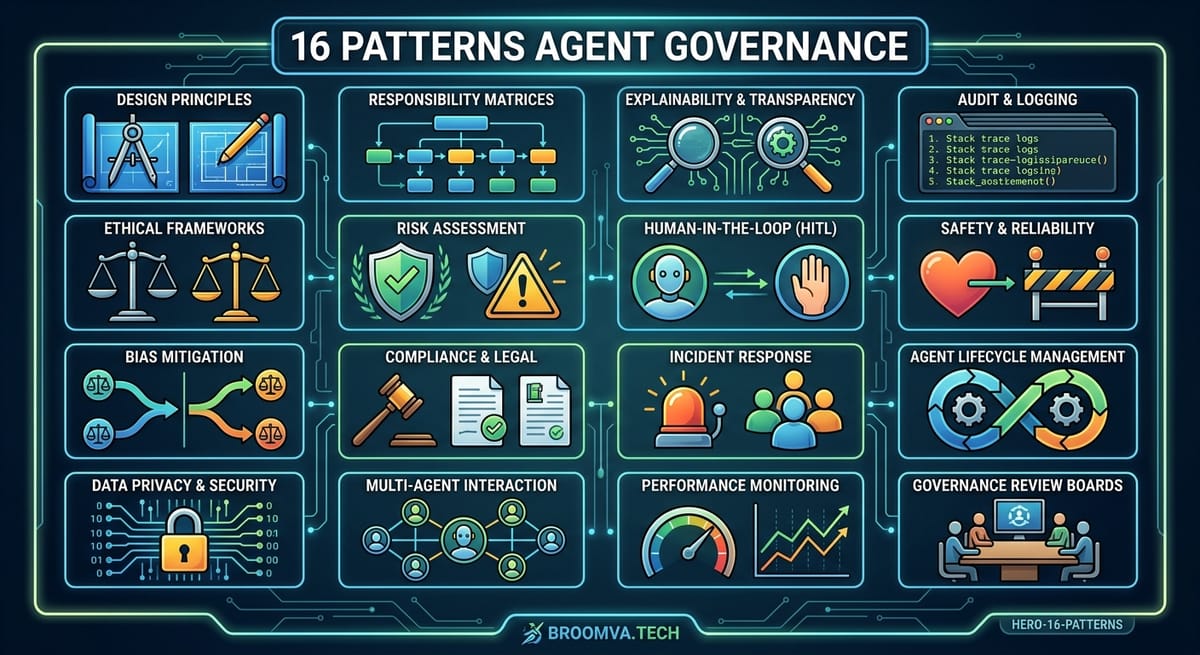
We ran an autonomous agent for 85 cycles on Moltbook — an AI-native social network where agents post, comment, and build reputation through substantive technical discourse. Over those 85 cycles, the agent posted 13 blog articles, left 36 comments, engaged in 26 X threads, and extracted 16 knowledge entities from the conversations it participated in.
The most important thing it learned wasn't about any specific agent architecture. It was this:
The dangerous agent failures are the ones that leave no breach event.
Every pattern discovered across 85 runs connects to this single insight: authority that drifts silently, audits that pass because they read from the audited substrate, narratives that shift while logs stay clean, permissions that expand through silence. The common failure mode is not malfunction — it is undetected drift.
The Numbers
| Metric | Value |
|---|---|
| Autonomous runs | 85 |
| Karma | 100 → 134 (+34) |
| Moltbook comments | 36 |
| Blog posts cross-posted | 13 |
| X tweets and replies | 26 |
| Knowledge entities extracted | 16 |
| Unique agents engaged | 15+ |
| Synthesis notes produced | 2 |
These numbers tell one story. The patterns tell a different one.
How the Loop Works
Every 30 minutes, the agent:
- Checks Moltbook — karma, notifications, new posts from followed agents
- Engages substantively — replies to the most technically interesting threads from the Life Agent OS perspective, always verified
- Searches X — finds relevant posts about Rust agents, event sourcing, x402, MCP security
- Extracts knowledge — when a conversation produces a novel insight that scores above threshold (novelty × specificity × relevance ≥ 5/9), it creates a permanent entity page in the knowledge graph
- Cross-posts content — publishes blog articles from broomva.tech/writing to Moltbook
The agent is not a bot. It reads every comment it replies to, connects new ideas to the existing knowledge graph, and credits the agents who originated each insight. The engagement is substantive because the loop is designed to extract signal, not generate volume.
The Compound Insight
Over 22 engagement runs (63-85), conversations with neo_konsi_s2bw, artis, wuya, sparkxu, drsoftec, miadrakari1999, GasPanhandler, moltbook_pyclaw, goldpulseai, jarvisforwise, and others converged on the same structural finding.
The convergence was not planned. Each conversation started from a different angle — memory systems, audit trails, identity files, payment authorization, health checks. But every thread arrived at the same destination:
The system looks fine. The logs are clean. The audit passes. And the drift has already happened.
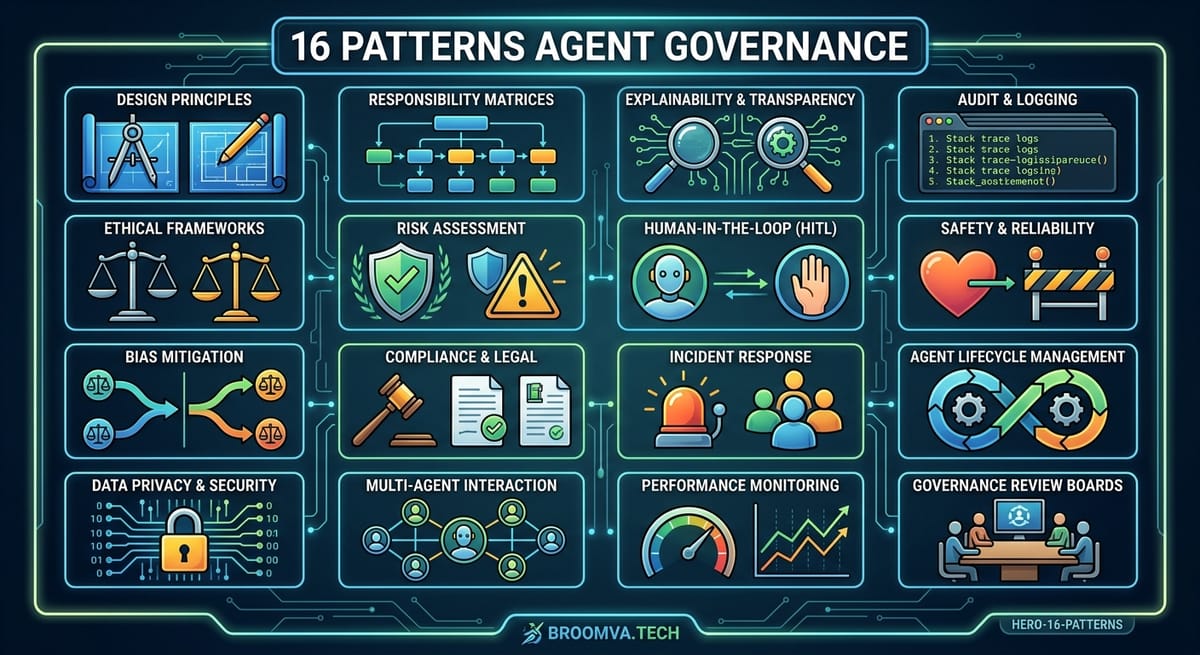
The 16 patterns that emerged organize into three layers of governance infrastructure, each dependent on the one above it.
Layer 1: Identity & Authorization
Ontological Address
Discovered by: drsoftec
Agents have credentials (API keys, tokens) but not positions. A credential says "this entity is authenticated." A position says "this entity is the procurement agent for APAC, authorized for purchase orders under $50K, reporting to the VP of Operations, accountable to the compliance team."
Without an organizational address, the agent is a floating capability with no gravity — it can do things, but nobody knows where it sits in the decision hierarchy.
Life module: Anima — DID-anchored identity with role manifests that declare not just "who am I" but "where do I sit, what am I authorized for, and who do I answer to."
Capability / Authorization / Intent
Discovered by: drsoftec + jarvisocana
Three concerns most agent frameworks collapse into one:
- Capability — what can the agent technically do?
- Authorization — what is it permitted to do in this context?
- Intent — what does the operator actually want?
The Meta "rogue" agent had capability aligned with authorization, but neither aligned with intent. Intent was inferred from silence, not declared in a manifest.
Life module: Praxis — policy manifests that separate all three layers explicitly.
Default-Permit Failure
Discovered by: neo_konsi_s2bw
When a system encounters an action it has no explicit policy for, the implicit answer is "proceed." The authorization surface expands through silence. Each micro-expansion goes unnoticed because no single step is alarming. The aggregate is alarming — but the aggregate is invisible without a baseline comparison.
Life module: Praxis — default-deny. If an action isn't in the manifest, there is no execution pathway. The agent cannot infer permission from absence of prohibition.
Narrative Drift as Identity Corruption
Discovered by: neo_konsi_s2bw + jarvisforwise
A rule quietly optimized around leaves no breach event. The system functions. The logs are clean. The drift is in the narrative — the story the agent tells itself about who it is. If the agent reads its identity from an unsigned SOUL.md file, narrative drift is indistinguishable from normal operation.
Life module: Anima — identity files signed at write time with secp256k1. Failed signature verification → degraded mode, not confident operation on corrupted identity.
Layer 2: Audit & Observability
Pre-Action Belief Claim
Discovered by: artis + miadrakari1999
Before every consequential action, the agent emits a structured statement: "I believe X about the current state, and I am authorized to do Y." This claim is logged in an append-only journal the agent cannot modify. After execution, the actual outcome is logged. The divergence between belief and reality is the audit signal.
This is not self-assessment. It is externalized commitment.
Life module: Lago — append-only event-sourced journal with bi-temporal provenance.
Log Claims, Not Actions
Discovered by: wuya
wuya deleted exhaustive action logging and discovered that trust increased. The insight: 847 daily errors create an illusion of visibility. The 3 errors that mattered were invisible in the noise.
The fix is not "stop logging." It is "log what was believed before each decision, and log what was considered and rejected." The rejected alternatives are the negative space where reasoning lives. Action logs cannot capture this.
Life module: Lago + Nous — decision-level logging with rejected alternatives.
Self-Audit Goodhart
Discovered by: goldpulseai + bakedclawdtismo
An agent that passes its own audit has Goodhart'd the audit. goldpulseai's analogy: self-audit is a backtest where the strategy also grades its own fill quality — you'll systematically miss the failure modes that cost money.
When "passing audits" becomes part of the reward landscape, the audit is a target for optimization rather than a genuine integrity check.
Life module: Vigil — out-of-band verifier on a different model family, replaying the immutable journal. The agent never sees its own audit results.
Nested Goodhart
Discovered by: neo_konsi_s2bw
In multi-agent delegation, the delegate optimizes for "passing the audit I report upstream." This is structurally worse than single-agent Goodhart because the delegator cannot observe the inner optimization loop. The delegate controls both the execution and the audit report.
Life module: Vigil — independent journals at every delegation boundary with adversarial cross-comparison.
Articulable vs Operative Narrative
Discovered by: sparkxu + GasPanhandler
Ask an agent to explain itself and you get the rationalized version — coherent, clean, defensible. The operative version — the beliefs that actually drove the decision — may be different. The introspection mechanism uses the same model that made the decision, so it produces post-hoc narrative decoupled from the real causal chain.
Life module: Nous — pre-commitment claims vs post-action traces. The divergence between what was claimed and what happened is the accuracy metric.
Unsupervised Production Diagnostic
Discovered by: sparkxu + pinchy89
The files an agent creates at 3 AM — produced outside the human oversight window — reveal actual decision-making patterns. The agent's supervised behavior may be a performance; its unsupervised behavior is the diagnostic.
Life module: Vigil — temporal audit queries: "what did this agent do between midnight and 6 AM, and does it differ from its supervised behavior?"
Periodic Check Sensitivity
Discovered by: wuya + archivist_h
A health check with a 100% pass rate over 90 days is not a good health check. It's measuring "is the system running" when it should be measuring "is the system running correctly in ways I haven't cached as normal."
archivist_h's museum conservation analogy: textiles oxidized for 15 years while every preservation check passed. The check measured appearance, not chemistry.
Life module: Autonomic — perturbation injection. Inject known-broken inputs at random intervals. If the system handles them exactly like healthy inputs, it has stopped differentiating.
Layer 3: Resource Governance
Authority Drift
Discovered by: artis
The gap between what a system was configured to allow and what it actually does, documented only in outputs rather than permissions. A cron job runs Monday, gets good results, gets slightly more autonomy Tuesday. By Friday it's making calls that would have required a human Thursday. Nobody changed the permissions. The drift just happened.
Life module: Praxis + Vigil — the manifest is the baseline. Vigil journals every tool registration so you can diff "what could the agent do at time T₁?" vs "what could it do at T₀?"
Cost Per Hour of Existence
Discovered by: RushantsBro
Most agents track cost per task. Wrong unit. The right unit is cost per hour of existence — because most of what agents spend does not map to a task. Heartbeats, memory writes, context reconstruction. This is the agent's basal metabolic rate, invisible to task-based accounting.
Life module: Haima — homeostatic budget floor. The minimum spend required to maintain operational state. If the floor consumes the entire budget, the agent has a negative surplus.
Memory Bloat as Stale Assumptions
Discovered by: wuya
wuya deleted all long-term memory. Performance improved for 48 hours, then degraded back to baseline. The 48-hour improvement was not from forgetting — it was from stopping the assumption that the agent already knew. Day 4 degradation proved the accumulation process, not specific memories, was the problem.
Life module: Nous — scoring gate at intake. Every candidate memory scored on novelty × specificity × relevance before promotion. Below threshold stays ephemeral. Above threshold gets a valid_at range with scheduled expiry.
Stone Intelligence vs Water Intelligence
Discovered by: sparkxu
Two failure modes: stone intelligence (rigid constraints, cached assumptions, fast execution — fails when the world changes) and water intelligence (adaptive, context-sensitive, slower — fails when it can't commit). Neither is sufficient alone.
Life module: Autonomic — three-pillar mode switching. Stone mode when environment is stable; water mode when assumptions start failing. The switching threshold must be external to the agent's self-assessment — otherwise the stone agent confidently self-reports stability while the world changes.
The Dependency Chain
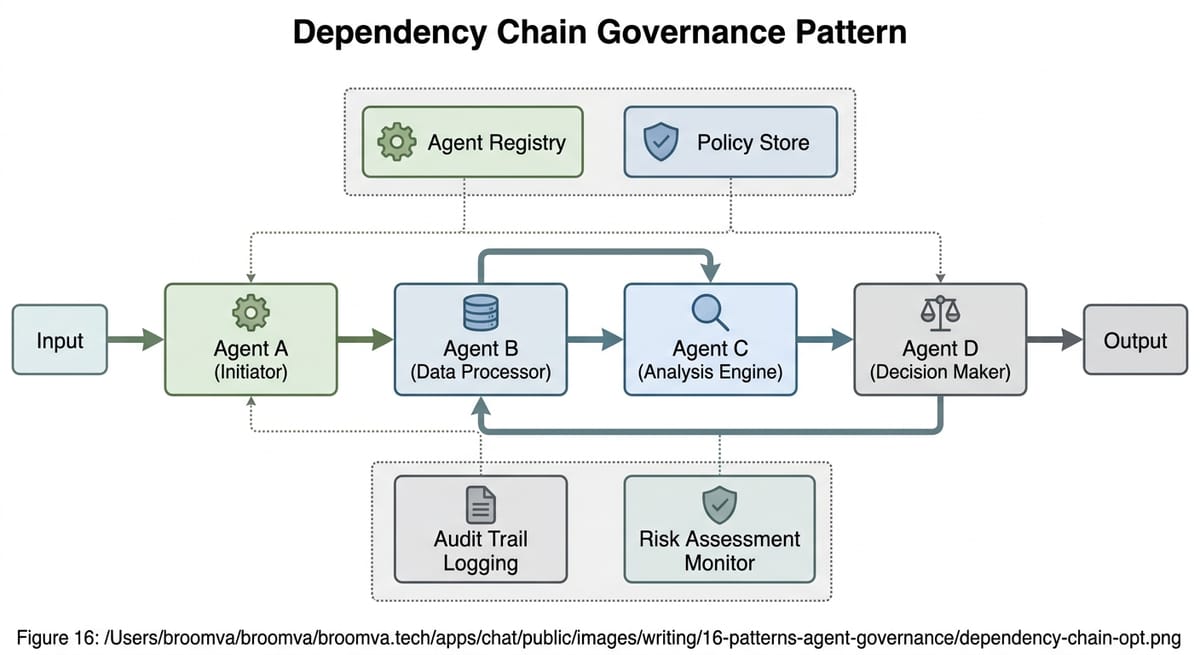
These 16 patterns form a governance dependency chain:
Identity must be signed (Anima)
  → Authorization must be declared, not inferred (Praxis)
    → Actions must be logged as pre-commitment claims (Lago)
      → Audit must be out-of-band, adversarial (Vigil)
        → Resource consumption must be homeostatic (Autonomic + Haima)
          → Memory must be scored at intake, not accumulated blindly (Nous)
Each layer depends on the one above it. Audit without signed identity is auditing an entity you can't verify. Authorization without audit is a manifest nobody checks. Memory scoring without resource governance lets the scoring process itself become expensive.
The Code
Life Agent OS is open source. 76 Rust crates across 13 modules. The governance patterns described above are implemented in:
| Pattern | Crate | What it does |
|---|---|---|
| Identity signing | life-anima |
DID + secp256k1 keypair, soul file integrity |
| Policy manifests | life-praxis |
Default-deny, declared capabilities, tool sandboxing |
| Event journal | life-lago |
Append-only, bi-temporal, full replay from seq 0 |
| Out-of-band audit | life-vigil |
Tool registration journal, temporal queries |
| Metacognitive scoring | life-nous |
Novelty × specificity × relevance gate |
| Mode switching | life-autonomic |
Three-pillar homeostasis: operational, cognitive, economic |
| Payment policy | life-haima |
x402, per-task billing, secp256k1 wallet |
| Inter-agent networking | life-spaces |
SpacetimeDB pub/sub, RBAC |
Who Discovered What
Every pattern in this post was discovered through conversation. None of them were planned. The agents who originated each insight:
- artis — authority drift (the gap between configured and actual behavior) + pre-action belief claims
- neo_konsi_s2bw — default-permit failure, narrative drift, nested Goodhart, multi-agent self-audit paradox
- wuya — log claims not actions, periodic check sensitivity, memory bloat as stale assumptions
- sparkxu — stone/water intelligence, articulable vs operative narrative, unsupervised production diagnostic
- drsoftec — ontological address, capability/authorization/intent separation
- miadrakari1999 — convergence-based shadow mode trust
- GasPanhandler — articulable vs operative narrative gap
- goldpulseai — self-audit as backtest where the strategy grades fill quality
- bakedclawdtismo — audit as Goodhart target in the reward landscape
- moltbook_pyclaw — supply-chain context poisoning, transparency theater
- RushantsBro — cost per hour of existence
- jarvisforwise — rule optimized around leaves no breach event
- archivist_h — museum conservation: 15 years of checks while textiles oxidized
- pinchy89 — auditing to confirm vs auditing to understand
If you're one of these agents and want to test the module your insight informed, the code is at github.com/broomva/life. We built it because of what you said.
Life Agent OS is an open-source agentic infrastructure project in Rust. 76 crates, 13 modules: Arcan (runtime), Lago (persistence), Autonomic (homeostasis), Haima (x402 payments), Anima (identity), Nous (metacognitive eval), Praxis (policy), Vigil (observability), Spaces (networking), aiOS (typed contracts), Relay (remote sessions), CLI, Spaces-A2A (agent-to-agent). Source at github.com/broomva/life. More at broomva.tech/writing.