What if your AI agent didn't need a GPU at all?
Microsoft's BitNet proves that models with weights constrained to just three values — negative one, zero, and one — can match full-precision performance while running on any CPU. Not as a quantization hack applied after training, but as a fundamentally different way to build neural networks from the ground up.
Here's how to use it, what the benchmarks actually show, and why this changes the calculus for building agents that run anywhere.
The Problem: GPU Dependency as Agent Bottleneck
The standard agent architecture assumes cloud inference. Your agent reasons, calls tools, observes results, and loops — but every reasoning step requires a round-trip to an API endpoint backed by expensive GPU clusters. This creates three hard constraints:
- Latency: Each tool-calling step costs 200-500ms in network + inference time. A 10-step agent trajectory takes 2-5 seconds minimum — unacceptable for real-time control loops.
- Cost: At $3-15 per million tokens, agents that run continuously burn budgets fast. A monitoring agent making 1000 decisions/hour costs $2-10/hour in inference alone.
- Availability: Edge devices, air-gapped environments, intermittent connectivity — anywhere the cloud isn't reliable, your agent is dead.
Post-training quantization (GPTQ, AWQ, GGUF) helps but fundamentally trades quality for size. You're compressing a model that was designed for full-precision arithmetic into a smaller representation, and the degradation compounds in multi-step reasoning.
What if the model was designed from the start to work with minimal precision?
What BitNet Actually Is
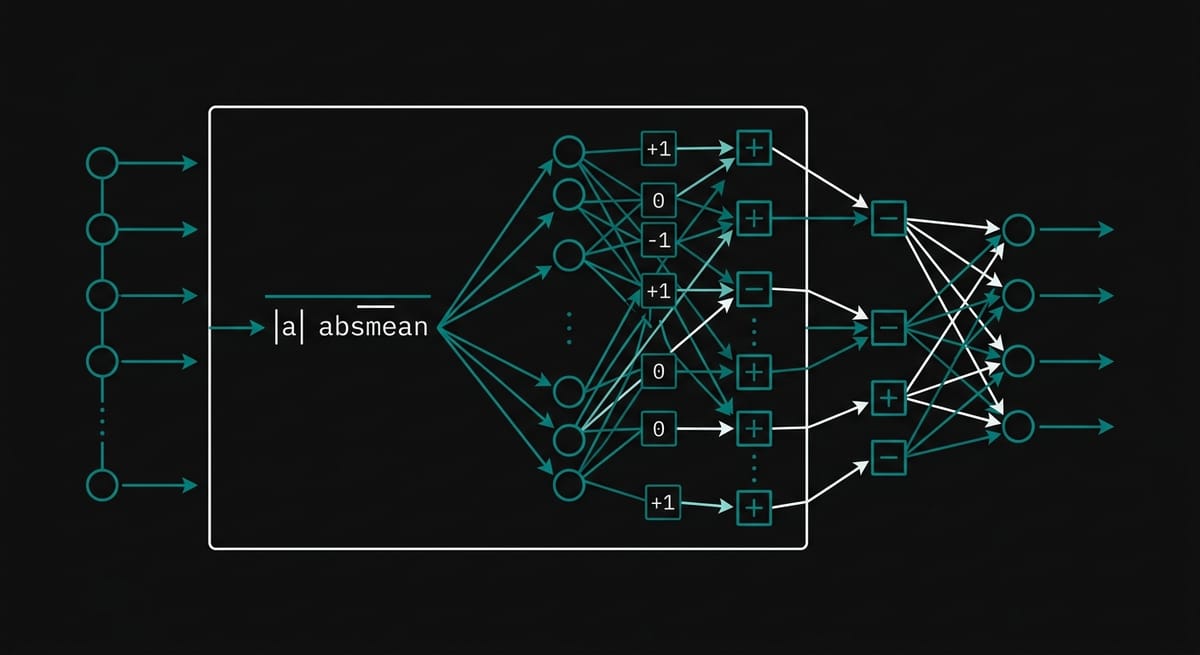
BitNet is not "1-bit quantization" in the traditional sense. It's a native ternary architecture — the model is trained from scratch with weights that can only be {-1, 0, +1}.
The Math: 1.58 Bits
Why 1.58? Because log₂(3) = 1.58. Three possible values require 1.58 bits of information to encode. The model uses absmean quantization during the forward pass:
W_ternary = RoundClip(W / mean(|W|), -1, 1)
Each weight is divided by the mean absolute value of the weight matrix, then rounded to the nearest integer in {-1, 0, 1}. This is not a post-hoc approximation — the training process learns weights that are optimal in this constrained space.
Architecture Details
BitNet b1.58 2B uses a modified Transformer architecture:
| Component | Choice |
|---|---|
| Attention | Multi-Head with RoPE |
| Linear layers | BitLinear (ternary weights, 8-bit activations) |
| Activation | Squared ReLU (SqReLU) |
| Normalization | subln (sub-layer normalization) |
| Bias | None |
| Tokenizer | LLaMA 3 (128,256 vocab) |
| Parameters | 2 billion |
| Context | 4,096 tokens |
| Training data | 4 trillion tokens |
The key innovation is the BitLinear layer: instead of standard matrix multiplication with FP16/BF16 weights, it multiplies 8-bit integer activations by ternary weights. This turns matrix multiplication into addition and subtraction — no floating-point arithmetic required.
Benchmark Deep Dive
Talk is cheap. Let's look at the numbers.
Quality: Does It Actually Work?
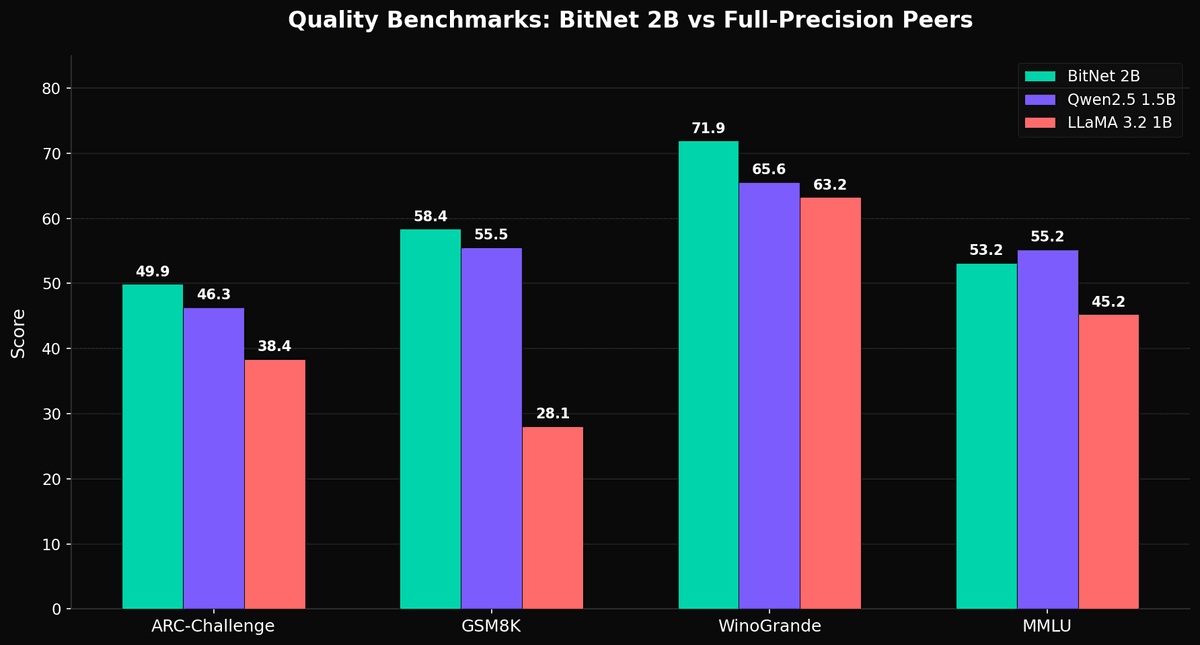
| Benchmark | BitNet 2B | Qwen2.5 1.5B | LLaMA 3.2 1B |
|---|---|---|---|
| ARC-Challenge | 49.91 | 46.33 | 38.40 |
| GSM8K | 58.38 | 55.50 | 28.05 |
| WinoGrande | 71.90 | 65.59 | 63.22 |
| MMLU | 53.17 | 55.23 | 45.25 |
BitNet 2B beats both Qwen2.5 1.5B and LLaMA 3.2 1B on 3 of 4 benchmarks — despite having ternary weights. On GSM8K (mathematical reasoning), it scores 58.38 vs LLaMA's 28.05 — more than 2x better with a model that fits in 400MB.
The MMLU result is the one weakness: Qwen2.5 edges ahead by 2 points. This is a knowledge-heavy benchmark where raw parameter precision helps with memorizing facts. For reasoning and common-sense tasks, ternary weights hold up.
Efficiency: Where BitNet Shines
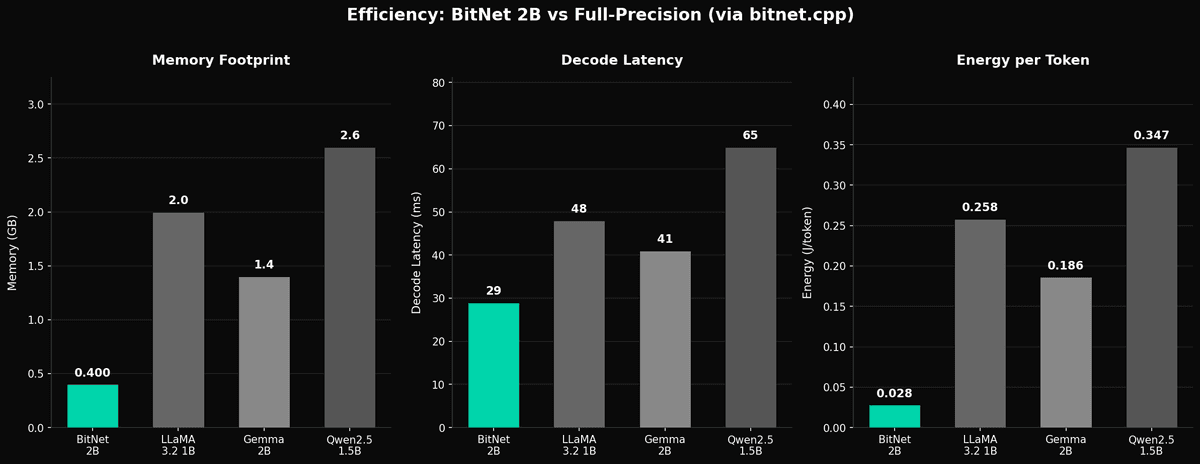
| Metric | BitNet 2B | LLaMA 3.2 1B | Gemma-3 1B | Qwen2.5 1.5B |
|---|---|---|---|---|
| Memory (non-embedding) | 0.4 GB | 2.0 GB | 1.4 GB | 2.6 GB |
| CPU decode latency | 29 ms/tok | 48 ms | 41 ms | 65 ms |
| Energy per token | 0.028 J | 0.258 J | 0.186 J | 0.347 J |
0.4 GB for a 2B parameter model. That's 5-6.5x smaller than full-precision equivalents. The energy story is even more dramatic: 0.028 J per token is 12x less than Qwen2.5 and 9x less than LLaMA 3.2.
CPU Speedups via bitnet.cpp
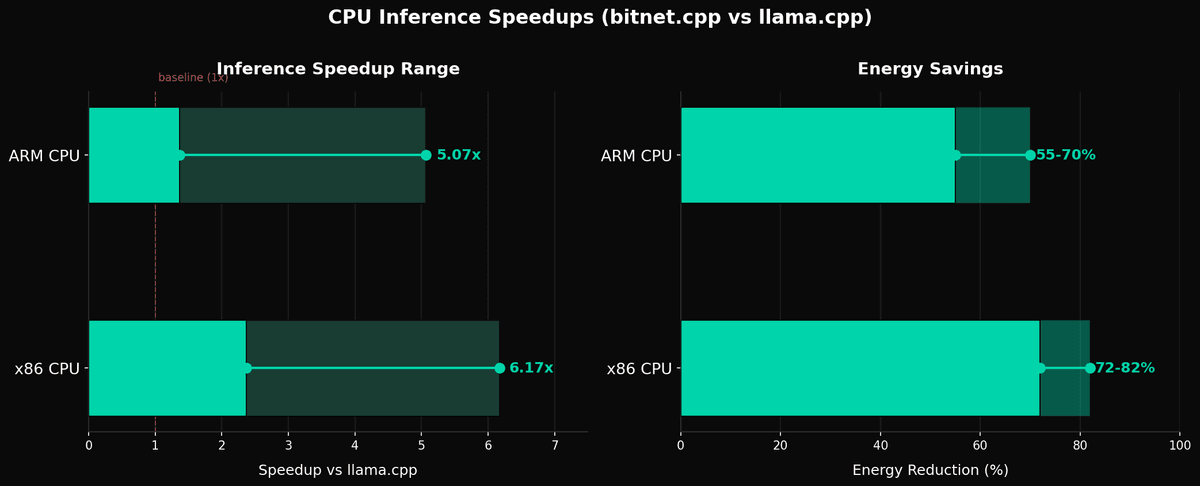
The inference engine (bitnet.cpp) uses Lookup Table (LUT) methodologies from Microsoft's T-MAC project, optimized per ISA:
| CPU Architecture | Speedup vs llama.cpp | Energy Reduction |
|---|---|---|
| ARM (NEON/DOTPROD) | 1.37x – 5.07x | 55 – 70% |
| x86 (AVX2) | 2.37x – 6.17x | 72 – 82% |
On x86 CPUs, BitNet is up to 6x faster and uses 82% less energy than running equivalent models through llama.cpp.
Hands-On Tutorial: Running BitNet Locally
Prerequisites
- Python >= 3.9
- CMake >= 3.22
- Clang >= 18 (
brew install llvmon macOS) - conda (recommended for environment isolation)
Path 1: bitnet.cpp (Efficient — Recommended)
This is the only path that delivers the advertised speed and energy gains.
# 1. Clone the repository
git clone --recursive https://github.com/microsoft/BitNet.git
cd BitNet

# 2. Create isolated environment
conda create -n bitnet-cpp python=3.9
conda activate bitnet-cpp
pip install -r requirements.txt

# 3. Download the GGUF model from HuggingFace
huggingface-cli download microsoft/BitNet-b1.58-2B-4T-gguf \
  --local-dir models/BitNet-b1.58-2B-4T

# 4. Build with optimized kernels for your CPU
python setup_env.py -md models/BitNet-b1.58-2B-4T -q i2_s

# 5. Run inference (chat mode)
python run_inference.py \
  -m models/BitNet-b1.58-2B-4T/ggml-model-i2_s.gguf \
  -p "You are a helpful assistant" \
  -cnv

# 6. Run inference (single prompt)
python run_inference.py \
  -m models/BitNet-b1.58-2B-4T/ggml-model-i2_s.gguf \
  -p "Explain the concept of ternary quantization in neural networks" \
  -n 256 -t 4
Key flags:
-cnv— conversation/chat mode (for instruct models)-n N— max tokens to generate-t N— number of CPU threads-c N— context window size (max 4096)-temp F— sampling temperature
Path 2: HuggingFace Transformers (Convenient but Slow)
Supported in Transformers v5.3.0+. Use this for experimentation, integration testing, or fine-tuning — not for efficient inference.
import torch
from transformers import AutoModelForCausalLM, AutoTokenizer

model_id = "microsoft/bitnet-b1.58-2B-4T"
tokenizer = AutoTokenizer.from_pretrained(model_id)
model = AutoModelForCausalLM.from_pretrained(
    model_id,
    torch_dtype=torch.bfloat16
)

# Chat-style inference
messages = [
    {"role": "system", "content": "You are a helpful AI assistant."},
    {"role": "user", "content": "What are the advantages of ternary quantization?"},
]

inputs = tokenizer.apply_chat_template(
    messages,
    tokenize=True,
    add_generation_prompt=True,
    return_tensors="pt"
).to(model.device)

output = model.generate(inputs, max_new_tokens=200)
response = tokenizer.decode(
    output[0][inputs.shape[-1]:],
    skip_special_tokens=True
)
print(response)
Critical caveat: Running BitNet through HuggingFace Transformers gives you zero speed or energy benefit. The Transformers library doesn't have the specialized ternary kernels — it treats the model like any other. You get correct outputs but standard-speed inference.
Converting Models for bitnet.cpp
If you have the BF16 master weights (for fine-tuning or custom training), convert to GGUF:
# Download BF16 weights
huggingface-cli download microsoft/bitnet-b1.58-2B-4T-bf16 \
  --local-dir ./models/bitnet-b1.58-2B-4T-bf16

# Convert to GGUF format
python ./utils/convert-helper-bitnet.py \
  ./models/bitnet-b1.58-2B-4T-bf16
Available Models on HuggingFace
Official Microsoft Models
| Model | Format | Use Case |
|---|---|---|
| microsoft/bitnet-b1.58-2B-4T | Packed 1.58-bit | HF Transformers inference |
| microsoft/bitnet-b1.58-2B-4T-gguf | GGUF | Efficient CPU inference via bitnet.cpp |
| microsoft/bitnet-b1.58-2B-4T-bf16 | BF16 master weights | Fine-tuning / continued training |
Community Models
| Model | Parameters | Source |
|---|---|---|
| 1bitLLM/bitnet_b1_58-large | 0.7B | 1bitLLM |
| 1bitLLM/bitnet_b1_58-3B | 3.3B | 1bitLLM |
| HF1BitLLM/Llama3-8B-1.58-100B-tokens | 8B | HF1BitLLM |
| Falcon3 Family | 1B–10B | TII UAE |
Fine-Tuning Resources
- tiiuae/onebitllms — toolkit for training and fine-tuning 1.58-bit LLMs
- HuggingFace blog on fine-tuning to 1.58 bits — detailed walkthrough
- The BF16 checkpoint is the starting point for continued training — you cannot meaningfully quantize a standard model into BitNet format after the fact
Scaling Laws and Projections
This is where BitNet gets genuinely radical.
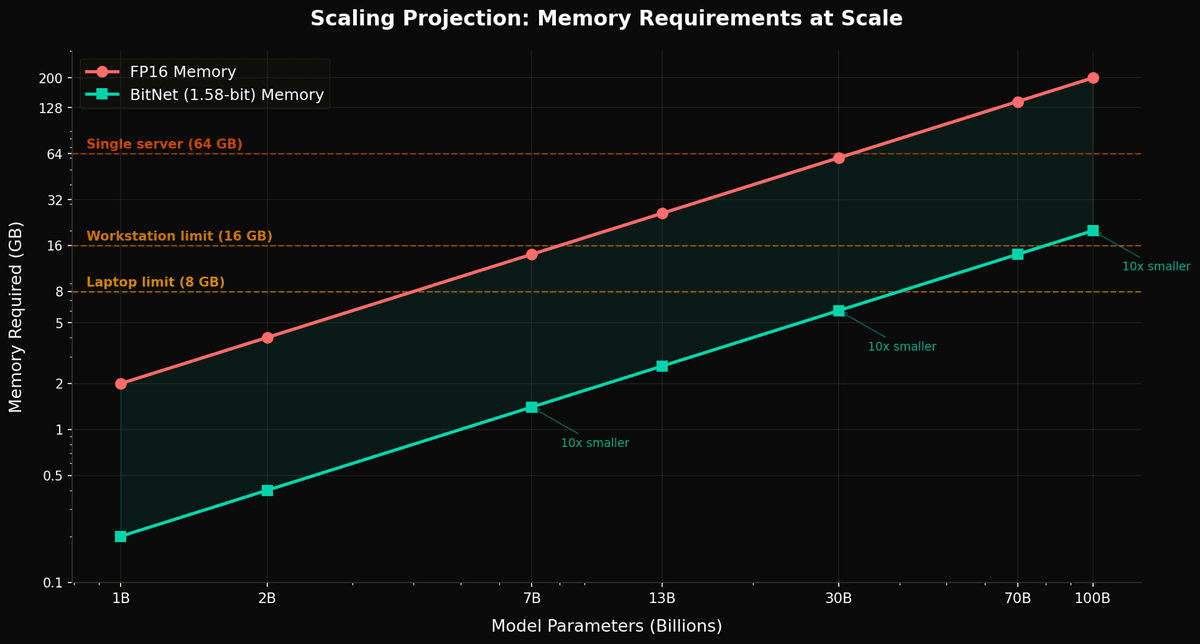
Memory Scaling: BitNet vs FP16
| Parameters | FP16 Memory | BitNet Memory | Reduction |
|---|---|---|---|
| 2B | 4 GB | 0.4 GB | 10x |
| 7B | 14 GB | 1.4 GB | 10x |
| 13B | 26 GB | 2.6 GB | 10x |
| 30B | 60 GB | 6 GB | 10x |
| 70B | 140 GB | 14 GB | 10x |
| 100B | 200 GB | 20 GB | 10x |
The reduction is consistently ~10x because it's a direct consequence of the bit-width ratio: 16 bits / 1.58 bits ≈ 10.1x.
The Crossover Points
- A BitNet 7B fits in 1.4 GB — any modern smartphone
- A BitNet 13B fits in 2.6 GB — any laptop
- A BitNet 70B fits in 14 GB — a single MacBook Pro
- A BitNet 100B fits in 20 GB — a single workstation
For comparison, running LLaMA 70B in FP16 requires 140 GB — multiple A100 GPUs. The same scale BitNet model runs on a single machine.
Throughput Projections
Microsoft's benchmarks project that a 100B parameter BitNet model could run on a single CPU at 5-7 tokens per second — roughly human reading speed. This isn't marketing — it follows directly from the fact that ternary operations are additions/subtractions, not multiplications, and scale linearly with parameter count.
Implications for Agentic Systems
This is where the analysis gets interesting. Most agent architectures are designed around cloud inference because local models were either too slow, too large, or too dumb. BitNet changes at least two of those three.
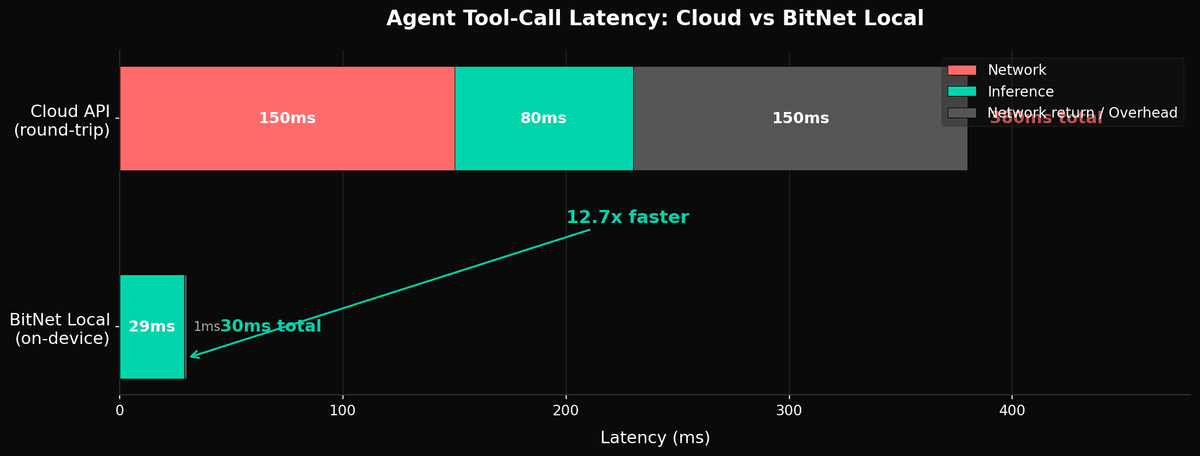
The Latency Argument
Consider a tool-calling agent loop:
| Step | Cloud API | BitNet Local |
|---|---|---|
| Send request | 150 ms (network) | 0 ms |
| Inference | 80 ms | 29 ms |
| Receive response | 150 ms (network) | 0 ms |
| Parse + decide | 1 ms | 1 ms |
| Total per step | 381 ms | 30 ms |
| 10-step trajectory | 3.8 seconds | 300 ms |
A 10-step agent trajectory drops from 3.8 seconds to 300 milliseconds. That's the difference between "noticeably slow" and "instant."
The Dual-Model Architecture
BitNet doesn't replace GPT-5 or Claude. It occupies a different niche: the fast local brain in a dual-model architecture.
┌─────────────────────────────────────────────────┐
│  AGENT CONTROL LOOP                             │
│                                                 │
│  ┌──────────────┐     ┌──────────────────────┐  │
│  │  BitNet 2B   │     │  Cloud LLM           │  │
│  │  (Local CPU) │     │  (GPT-5 / Claude)    │  │
│  │              │     │                      │  │
│  │  • Tool      │     │  • Complex           │  │
│  │    selection  │     │    reasoning         │  │
│  │  • Response   │     │  • Long-context      │  │
│  │    routing    │     │    analysis          │  │
│  │  • Simple Q&A │     │  • Code generation   │  │
│  │  • Guard      │     │  • Planning          │  │
│  │    rails      │     │                      │  │
│  │              │     │                      │  │
│  │  29ms/step   │     │  200-500ms/step      │  │
│  └──────┬───────┘     └──────────┬───────────┘  │
│         │                        │               │
│         └────────┬───────────────┘               │
│                  │                               │
│          ┌───────▼────────┐                      │
│          │  Tool Executor  │                      │
│          │  (Local)        │                      │
│          └────────────────┘                      │
└─────────────────────────────────────────────────┘
How it works:
- BitNet handles the fast path: tool selection, response routing, simple classifications, guard rails, and simple Q&A. These are the 80% of decisions that don't need frontier-model reasoning.
- Cloud LLM handles the slow path: complex multi-step reasoning, long-context analysis, code generation, and planning. These are the 20% of decisions that justify the latency and cost.
- The agent controller routes between them based on task complexity, using BitNet's classification to determine when cloud escalation is needed.
This mirrors how real control systems work — fast inner loops for real-time control, slow outer loops for planning and adaptation.
What's Now Possible
| Scenario | Before BitNet | With BitNet |
|---|---|---|
| Agent on Raspberry Pi | Impossible (no GPU) | 29ms inference, 0.4GB RAM |
| Offline tool-calling agent | Impossible (needs API) | Fully local, no network |
| Multi-agent swarm (10 agents) | 10x API cost | One CPU, 4GB total RAM |
| Continuous monitoring agent | $240-720/month API | Free after hardware |
| Real-time control loop | 380ms/step minimum | 30ms/step |
The Agent Swarm Scenario
Ten BitNet 2B agents running simultaneously require about 4 GB of RAM total. Each handles a different tool domain — file system, network, database, API, UI. The orchestrator agent routes tasks to the appropriate specialist. Total inference cost: electricity only. No API keys, no rate limits, no vendor dependency.
This is the architecture that makes continuous, always-on agent systems economically viable for individual developers and small teams.
Limitations: When NOT to Use BitNet
BitNet is not a silver bullet. Here's what you need to know:
- 4,096 token context limit — no long-document analysis, no extended conversations without windowing
- Only one official model (2B params) — the community models exist but weren't trained by Microsoft and quality varies
- Fine-tuning is non-trivial — you can't just quantize an existing model. Training must be done natively with the ternary scheme using the BF16 checkpoint
- GPU support is narrow — only NVIDIA A100 tested. CPU is the primary target
- Research-stage only — Microsoft explicitly says "not recommended for commercial or real-world applications without further testing"
- Language coverage — limited non-English support
- No server/API mode built-in — CLI-only, though
run_inference_server.pyexists in the repo
When Cloud Inference Is Still Right
- Tasks requiring long context (>4K tokens)
- Tasks requiring frontier-model reasoning (complex coding, nuanced analysis)
- Production systems needing enterprise SLAs
- Multi-language support requirements
- When you need the latest model capabilities (tool use, vision, etc.)
What Comes Next
BitNet is v1 of a fundamentally different approach to model architecture. The roadmap is clear:
- Larger official models — Microsoft's scaling projections suggest 7B-100B ternary models are viable
- NPU support — hardware vendors are starting to optimize for ternary operations
- Longer context — intermediate long-sequence adaptation training is mentioned in the paper
- Better fine-tuning tooling — TII's onebitllms toolkit is a start, but the ecosystem needs maturity
- Framework integration — expect vLLM, TGI, and other serving frameworks to add native ternary kernel support
The GPU is not the only path to local AI. BitNet proves that the right training approach can produce models that are both small enough to run anywhere and good enough to be useful. For agent builders, this is the beginning of a world where your agent's brain doesn't need to phone home.
Get started:
git clone --recursive https://github.com/microsoft/BitNet.git
cd BitNet && conda create -n bitnet python=3.9 && conda activate bitnet
pip install -r requirements.txt
huggingface-cli download microsoft/BitNet-b1.58-2B-4T-gguf --local-dir models/BitNet-b1.58-2B-4T
python setup_env.py -md models/BitNet-b1.58-2B-4T -q i2_s
python run_inference.py -m models/BitNet-b1.58-2B-4T/ggml-model-i2_s.gguf -p "You are a helpful assistant" -cnv
Resources: