The Claude Code source map leak revealed something more interesting than unreleased features — it exposed a production-grade agent architecture where every reliability mechanism is a constraint, not a capability upgrade. Here's what 512K lines of TypeScript teach us about building agent systems that actually work.
Disclaimer: All code snippets in this post are illustrative pseudocode based on publicly reported analysis — no actual source code is reproduced. This is architectural commentary, not a source dump.
The Leak
On March 31, 2026, a .map source map file was accidentally included in @anthropic-ai/claude-code version 2.1.88 on npm. It pointed to a zip archive containing the full TypeScript source. Anthropic pulled the package within hours, but mirrors had already spread everywhere.
A sourcemap is designed to undo minification. This one contained sourcesContent — the complete original source of all 1,884 files, inline. Someone just ran npm pack, extracted the tarball, and parsed the .map file. Every original filename, variable name, and comment — restored.
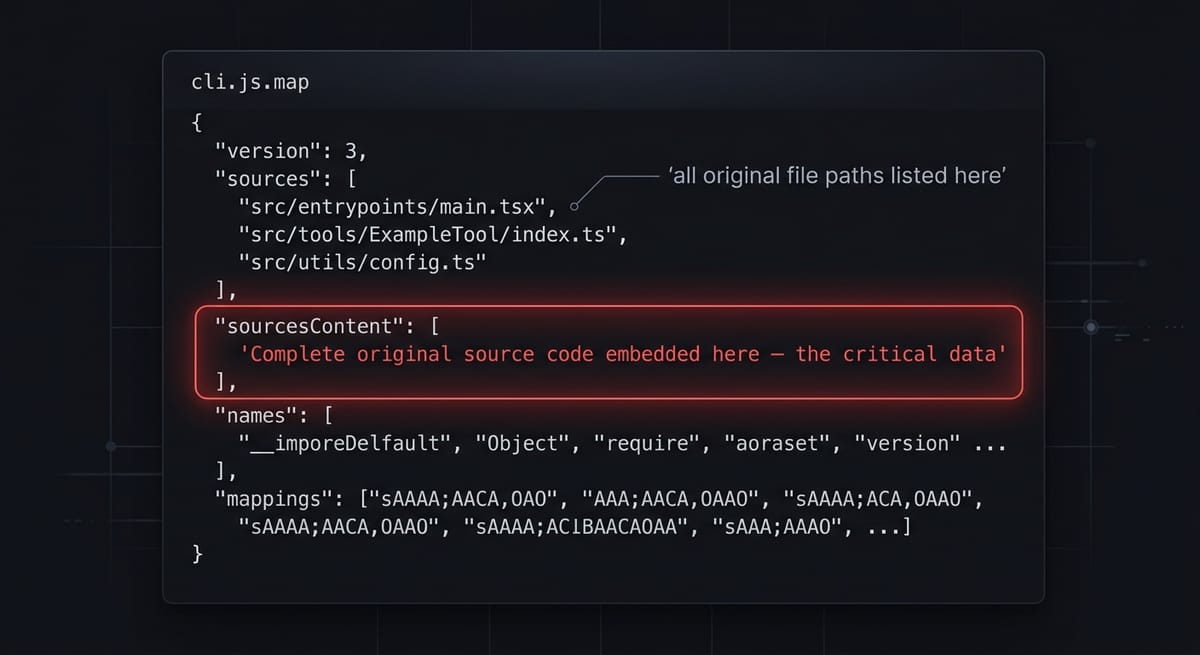
The DMCA response was aggressive — 8,100+ GitHub repos disabled. But the architectural knowledge is out. And it's worth studying, because Claude Code isn't just a chat wrapper. It's a 2,000+ file, 43-tool, 85-hook agent runtime with patterns that solve problems the entire industry is struggling with.
The Build Pipeline: Source to Your Machine
Before the architecture, the build pipeline. This is where the first layer of reliability lives.
2,000+ TypeScript files go through bun:bundle — Bun's native bundler. During bundling, 32 compile-time feature flags are evaluated. Every flag set to false causes the bundler to tree-shake the entire associated code path. The code isn't hidden — it's physically eliminated from the output.
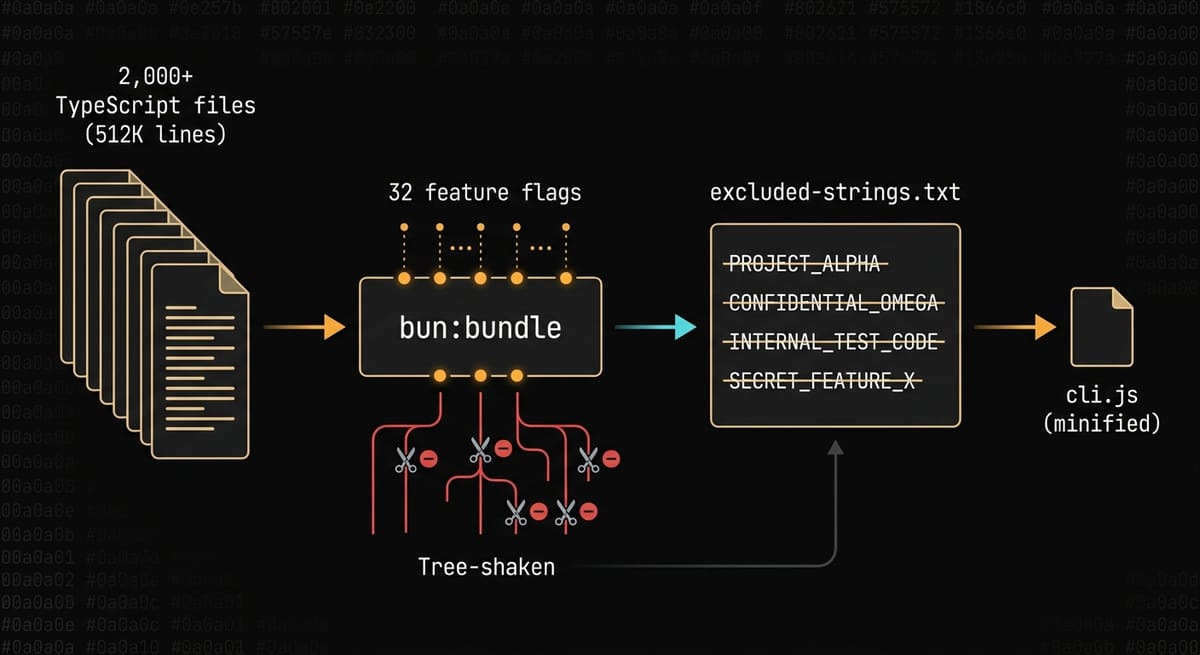
But there's another layer: a string blocklist that removes internal codenames from the output. Sensitive strings are encoded as individual charCodes to survive the filter:
// Illustrative pattern — not actual source:
// Instead of: const name = "InternalName"
const name = String.fromCharCode(73,110,116,101,114,110,97,108)
The result is a single minified cli.js. No directory structure, no filenames, no folder organization. And the "protection" before the leak was just this:
- Minification — variables renamed to
a,b,c - Tree-shaking — disabled features physically absent
- String stripping — codenames removed
- Single bundle — one flat file
None of this is encryption. JavaScript can't truly be hidden — it runs in a JS engine that needs to read it. The leak happened because cli.js.map shipped in the npm package. A one-line .npmignore oversight.
Three-Layer Feature Flag Architecture
This is the system that determines which features exist, which are active, and who gets what. It's a funnel, not a switch.
Layer 1: Build-Time Flags (32 Switches)
Compile-time constants evaluated by bun:bundle. Think C preprocessor #ifdef, but for a TypeScript CLI:
if (feature('KAIROS')) {
  registerTool(SleepTool);
  registerCommand('/dream');
}
When Anthropic builds the npm package, they decide which flags are true. The bundler tree-shakes everything behind disabled flags — that code doesn't exist in the shipped binary. 32 flags controlling whether entire code paths ship.
Layer 2: GrowthBook Runtime Gates
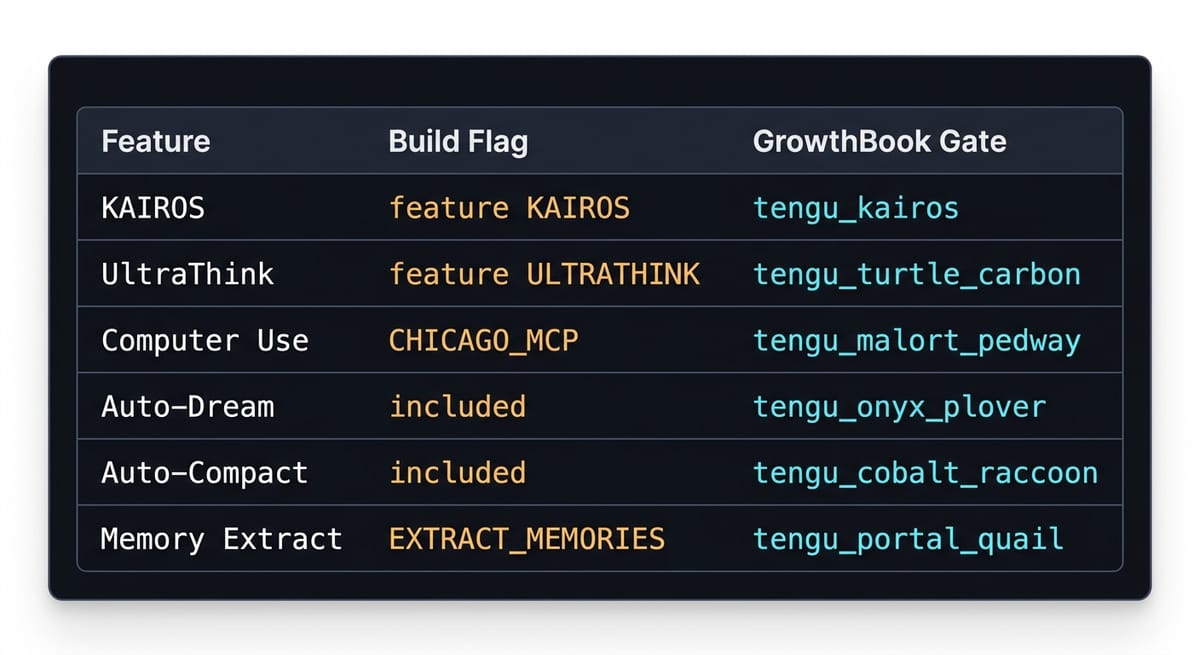
Code existing in the binary doesn't mean it's active. At startup, Claude Code fetches feature flags from GrowthBook — a remote feature flag service. These are the tengu_* prefixed gates — server-side toggles Anthropic controls without deploying new code:
tengu_turtle_carbon— UltraThinktengu_malort_pedway— Computer Usetengu_onyx_plover— Auto-Dreamtengu_cobalt_raccoon— Auto-Compacttengu_portal_quail— Memory Extract
The naming is intentionally opaque. tengu_malort_pedway tells you nothing about Computer Use. Per-account rollout without touching the binary.
Layer 3: Env Var Overrides
The escape hatch. Force features on or off per session:
CLAUDE_CODE_COORDINATOR_MODE=1 claude
USER_TYPE=ant claude
Internal employees ("Ants") get different defaults — features always-on while external users are gated behind rollout flags.
The Dual-Gating Pattern
The key insight: most unreleased features use dual gating — both the build flag AND the GrowthBook gate must be true:
if (feature('KAIROS') && growthbook.isOn('tengu_kairos')) {
  enableKairosMode();
}
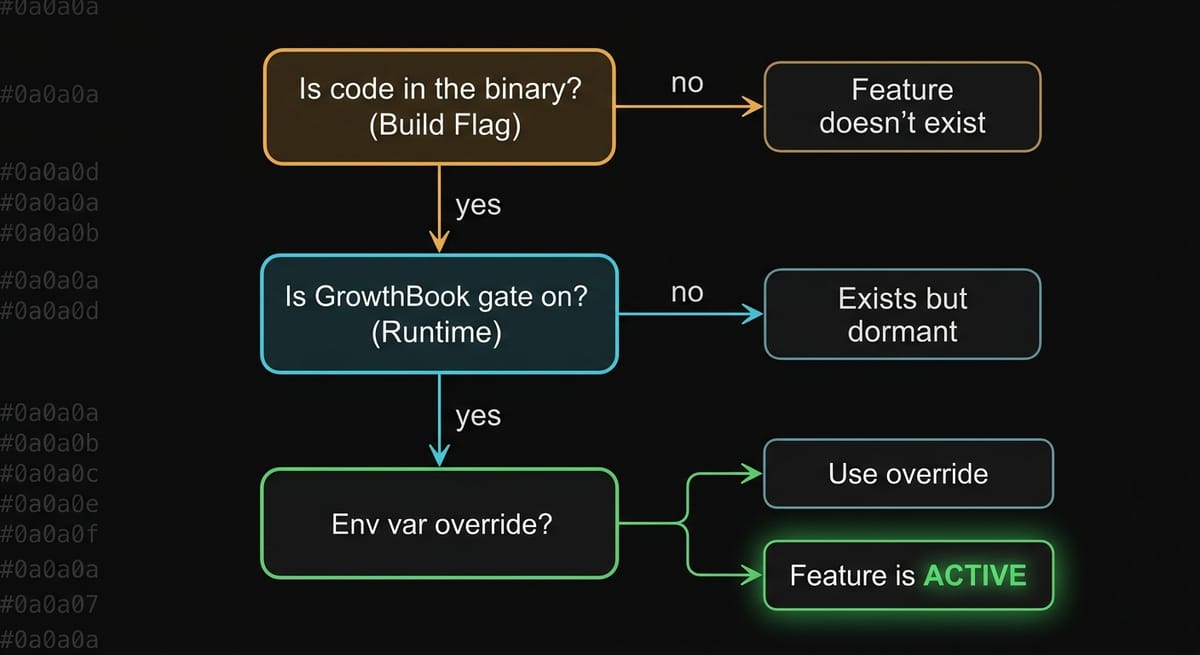
Even if you patch the binary to enable a build flag, GrowthBook still needs to return true for your account. The full decision chain is a funnel — each layer narrows what's possible.
The Memory Architecture: A Masterclass in Constraint
Claude Code's memory system is the most well-designed part of the codebase. It isn't "store everything" — it's constrained, structured, and self-healing.
Memory = Index, Not Storage
MEMORY.md is always loaded into context, but it's just pointers — approximately 150 characters per line, capped at 200 lines. Actual knowledge lives in separate topic files, fetched only when relevant.
Three bandwidth-aware layers:
| Layer | Behavior | When accessed |
|---|---|---|
Index (MEMORY.md) |
Always in context | Every turn |
| Topic files | Loaded on-demand | When relevant |
| Conversation transcripts | Never loaded | Only grep'd for search |
This is a universal information architecture pattern. Everything in Claude Code follows it — tools (43 core, deferred schemas, MCP catalogs), config (settings.json, CLAUDE.md hierarchy, rules), even features (build flags, GrowthBook gates, env overrides). Small hot layer, medium warm layer, large cold layer.
Four Memory Types
Each memory has a type field that determines retention, visibility, and how it gets injected into the system prompt:
| Type | Purpose | Lifespan |
|---|---|---|
user |
Role, preferences, knowledge level | Long-lived, cross-session |
feedback |
Corrections and confirmations | Learning signal, permanent |
project |
Goals, deadlines, ongoing work | Medium-lived, project-scoped |
reference |
Pointers to external systems, URLs | Stable, rarely changes |
Strict Write Discipline
The rule: write to the topic file first, then update the index. Never dump content into the index itself. This prevents entropy — the index stays small, the content stays organized. Memory files have YAML frontmatter (name, description, type) with markdown body.
Memory is Rewritten, Not Appended
A background process (autoDream) continuously edits memories:
- Merges duplicates
- Removes contradictions
- Converts vague references to absolute ("Thursday" becomes "2026-03-05")
- Aggressively prunes stale entries
This consolidation runs in a forked subagent with limited tool access — preventing corruption of the main context window. Memory is a living document, not a log.
Staleness is First-Class
If a memory contradicts the current codebase, the memory is wrong — not the code. Code-derived facts are never stored. The model must verify memories against current state before acting on them.
Retrieval is skeptical, not blind. Memory is a hint, not truth.
What They Don't Store is the Real Insight
No debugging logs. No code structure. No PR history. No git blame. No architecture diagrams.
If it's derivable from the current state of the repo, don't persist it. This is the opposite of how most "AI memory" systems work — they store everything and drown in noise. Claude Code stores almost nothing and stays sharp.
Memory as Side-Effect of Compaction
This is the architectural insight that ties everything together.
When context hits ~93% usage (187K of 200K tokens), auto-compact triggers. Claude summarizes old messages above a boundary marker, freeing ~40-60% of context. But the same compaction pass also extracts durable insights into memory files.
The pressure that forces forgetting also forces crystallization. More sessions mean more compaction, which means more memory extraction, which means better future context. It's a virtuous cycle driven by scarcity.
Context pressure → Summarization → Memory extraction
                → Old tokens freed    → Knowledge persists
Three compaction strategies work together:
- Auto-Compact: Triggers at ~93.5% context. Summarizes old messages. Frees 40-60% of context.
- MicroCompact: Per-tool-result compression. Only Bash, FileRead, Grep outputs. Runs every turn.
- Post-Compact Recovery: Restores up to 5 recently-read files (25K tokens) and runs background memory extraction.
Circuit breaker: if compaction fails 3 times consecutively, it stops trying. Fail-safe, not fail-hard.
Beyond Flags and Memory: Other Architectural Finds
The Scale
- 2,000+ source files, 512K lines TypeScript
- 43 built-in tools, 101 command directories, 85 React hooks, 144 UI components
- 24 MCP integration files across 6 transports
- Terminal UI: custom React reconciler backed by Yoga flexbox, ANSI diff renderer
- Boot sequence: 11 steps from
claudeto REPL
The entire terminal is React.
3-Layer Permission System
- Tool Registry Filter — blocked tools removed from context entirely. Claude never sees them.
- Per-Call Permission Check — allow/deny rules against tool name + arguments.
- Interactive User Prompt — ask once / always / deny.
Bash commands go through a full shell AST parser that detects rm -rf, fork bombs, curl|bash, sudo escalation, and TTY injection before execution. Structural analysis, not pattern matching.
Dual Authentication
Two parallel auth paths: OAuth tokens (prefixed sk-ant-oat01-) routing through a claude.ai proxy for subscription users, and direct API keys (prefixed sk-ant-api03-) hitting api.anthropic.com for pay-per-token users. Binary attestation via Zig HTTP stack — the server validates a computed hash to confirm requests come from the official binary.
Anti-Distillation
Fake tool definitions injected into system prompts to poison training data scraped from API traffic. Reasoning chains summarized cryptographically server-side. An "undercover mode" strips internal references from all outputs — always on, no opt-out.
8 Unreleased Features
- BUDDY — virtual pet with rarity tiers (Common to Legendary), 18 species
- KAIROS — persistent always-on mode with overnight "dream" memory consolidation
- ULTRAPLAN — 30-minute cloud-hosted planning sessions
- Coordinator Mode — multi-agent orchestration with parallel workers
- Bridge — remote control from phone/browser (now shipped)
- Daemon Mode — background sessions via
claude --bg - UDS Inbox — inter-session IPC via Unix domain sockets
- Auto-Dream — automatic memory organization after 5+ sessions
Telemetry Architecture
410+ distinct event names across dual pipelines (Datadog + first-party BigQuery). Dual-column PII protection where _PROTO_* fields carry unredacted data for privileged queries while general sinks only see redacted values. Disk-backed retry queue with quadratic backoff. Privacy cascade: three levels from "everything on" to "only API calls to the model provider."
The Compounding Error Problem
Here's where this analysis goes from "interesting reverse engineering" to "this matters for the industry."
The math of multi-agent systems is unforgiving. If each step has accuracy p, then n steps gives you p^n:
| Accuracy/Step | 5 Steps | 10 Steps | 20 Steps | 100 Steps |
|---|---|---|---|---|
| 95% | 77.4% | 59.9% | 35.8% | 0.6% |
| 90% | 59.0% | 34.9% | 12.2% | 0.003% |
| 85% | 44.4% | 19.7% | 3.9% | ~0% |
The industry response has been "use a bigger, more expensive model." Going from 85% to 95% per step costs 30x more in inference. But 95%^20 is still a coin flip. You can't outspend exponential decay.
Claude Code's answer to this is scattered across the codebase but consistent: every reliability mechanism is a constraint, not a capability upgrade.
- Permission gates can't be hallucinated past
- Dual-gating requires two independent systems to agree
- Memory verification demands current-state checks before acting
- AST-level bash parsing is structural, not heuristic
- Auto-compact circuit breakers are fail-safe, not fail-hard
The pattern: don't make agents think harder — make it structurally impossible for them to drift.
The Architecture That Wins
The industry is converging on the same solution from different directions:
Expensive models for planning, cheap models for execution. Claude Code uses Opus for design decisions and allows Haiku-class models for routine tool execution. The dual-gating pattern is exactly this — expensive compile-time decisions, cheap runtime checks.
Structured graphs for reliability. Whether it's Claude Code's permission gates, OpenServ's SERV Reasoning with explicit decision nodes, or workflow engines like Temporal — the pattern is the same. Constrained execution paths where the agent cannot freestyle, cannot drift, and cannot invent states that don't exist.
Audit trails for trust. Claude Code logs 410+ event types. Everything is traceable. In our own Life Agent OS, we take this further with event-sourced persistence (Lago) where every state change is an immutable event, and cryptographic agent identity (Anima) for on-chain verifiability.
Our Stack: Same Answer, Different First Principles
We've been building toward the same architectural answer in the Life Agent OS — an open-source Rust-based agent operating system:
| Problem | Claude Code's Answer | Life Agent OS Answer |
|---|---|---|
| Feature rollout | 3-layer flag funnel | .control/policy.yaml + EGRI evaluator |
| Execution reliability | Permission gates + AST parsing | Autonomic homeostatic regulation |
| Memory | memdir + skeptical retrieval | Lago event-sourced + lago-memory |
| Multi-agent coordination | Coordinator Mode | Symphony orchestrator |
| Planning vs execution split | Build-time vs runtime | Opus plans, Haiku executes |
| Shared state | Session storage | Lago event journal |
| Economic layer | Token budget tracking | Haima x402 agent payments |
| Audit trail | 410+ telemetry events | Event-sourced replay + Anima identity |
| Self-improvement | autoDream memory rewriting | Autoany EGRI loops |
The difference: they went flag-first (constrain what code ships), we went event-source-first (constrain what state changes are possible). Both converge on the same insight.
The Real Takeaway
The best feature flag systems aren't on/off — they're funnels. The best memory systems store almost nothing. The best agent architectures make failure structurally impossible rather than statistically unlikely.
512K lines of TypeScript is reproducible. The patterns — compaction-driven memory, dual-gating, three-layer bandwidth design, skeptical retrieval, constraint-first reliability — those are the actual intellectual property. And now they're public knowledge.
The moat isn't the model. It's the architecture around it.
Sources: VentureBeat, The Register, The Hacker News, GitHub DMCA transparency page, Decrypt, and community analysis. Full 35-tweet thread with diagrams at @broomva_tech.