TL;DR
We forked Houston — a proven, MIT-licensed runtime for watching AI coding agents work — and started grafting a different idea onto it: a runtime that doesn't just watch agents, it builds, on its own.
In one hack camp the fork went 89 commits ahead of upstream: 1,118 files changed, +101,906 / −21,310 lines, four net-new Rust crates, the engine grew from 17 to 21 crates. Six agents were building in parallel the whole time.
Those are the numbers everyone quotes. They are not the point. The point is how a number like that happens without the result being garbage — and that comes down to a method you can copy. This post is that method, illustrated by the features it produced. Every screenshot below is a real frame from a running build; the hero video above is a narrated walkthrough — the method, the product surface, and a live, git-verified screen capture of the running fork.
Dogfood evidence captured from the running fork
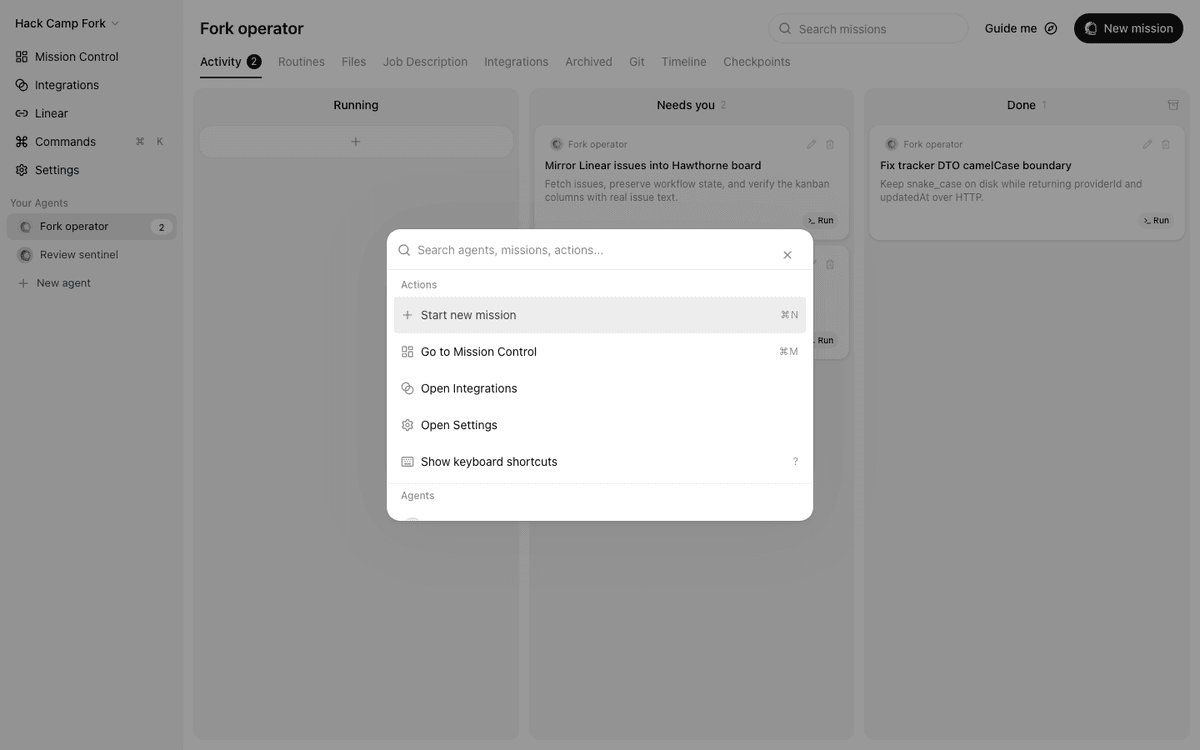
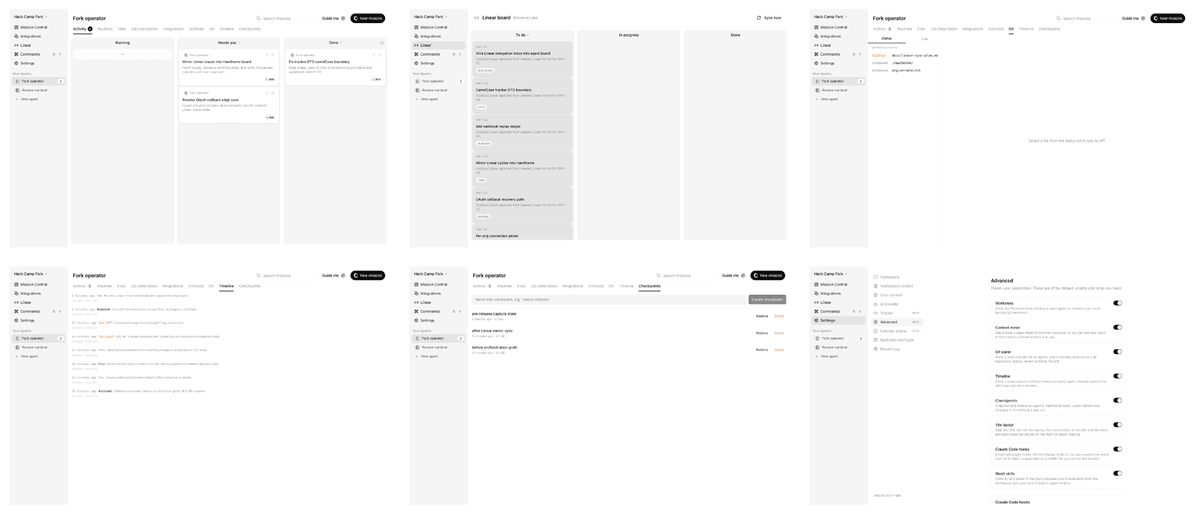
For this update I booted the Rust engine locally, pointed the web shell at it, seeded a realistic Hack Camp Fork workspace, and interacted with the app through the browser. The captures now show real data rather than blank feature frames.
- 2 workspace agents
- 3 activity cards
- 6 mirrored Linear issues
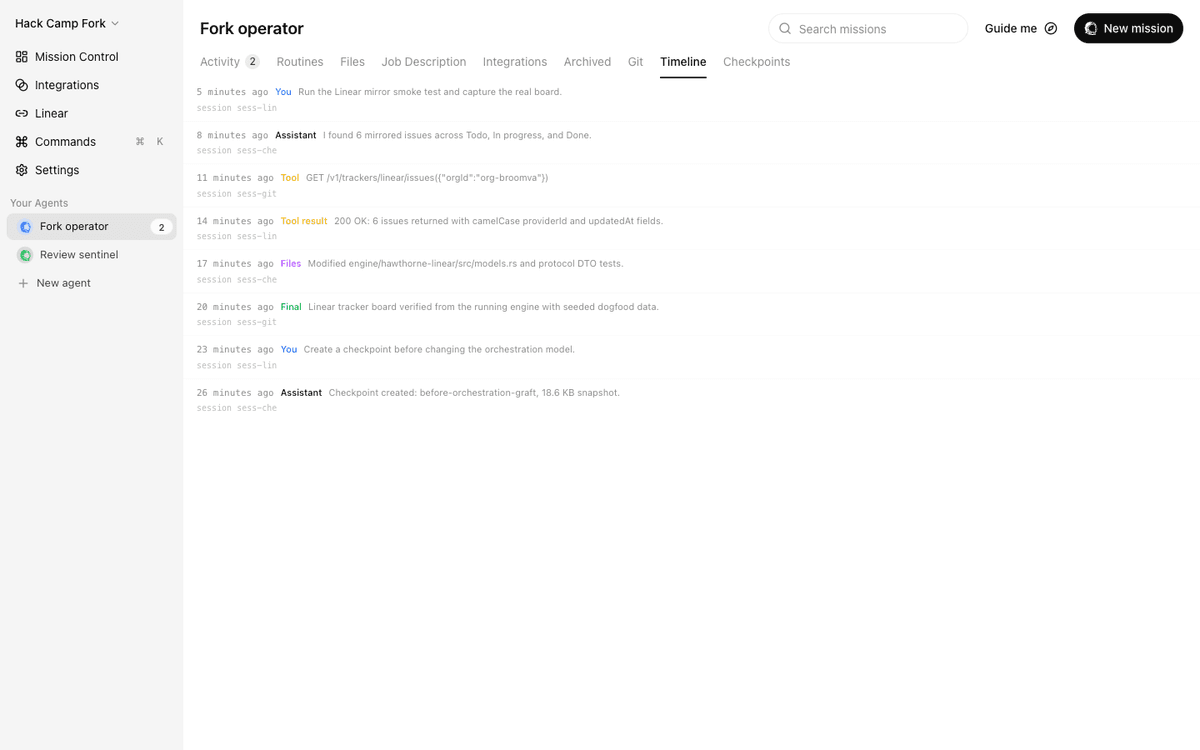
- 8 timeline events
- 3 checkpoints
- Dirty git repo with status + diff surface
The full additions ledger
Before the story of how, here's the what — everything the fork carries that upstream Houston doesn't, grouped by surface. The interactive version lives in the fork inventory showcase; the complete ledger is below. Every line is a real commit against gethouston/houston.
engine/houston-sandbox— the isolation control plane: oneSandboxPolicyover a pluggable backend registrycloud/— the managed-deploy vision (one engine per host, many tenants)always-on/— Dockerfile · compose · systemd · railway.jsonknowledge-base/cloud-compute.md— the two-planes (relay vs compute) model.dockerignore+ a PaaS$PORTentrypoint, so one image deploys anywhere
engine/houston-orchestration— the new brain crate- fs-canonical object model: Initiative → Project → Task → Cycle → Run
- markdown + YAML frontmatter on disk; the child-edge is authoritative
- multi-stage
blocked_by; aRunRefworktree per run - 11 / 11 ported unit tests green
houston-linear— full Linear tracker: OAuth, webhooks, mirror pipeline, in-shell board viewhouston-life— a Life-runtime client over a Unix socket (Stage-0 end-to-end)houston-claude-hooks— install / uninstall hooks in Claude Code- Native cross-review: a
request_reviewtool + a second-opinion doctrine
- Context-enablement wizard — import + synthesize workspace/user context
- "Help me write this" guided writer
- Advanced feature-flag surface: context meter, git panel, timeline, tile layout, checkpoints, worktrees
- Mobile: a Capacitor native shell + session handoff
- A tunnel / Notify push pipeline (APNs/FCM loc-keys)
- i18n en/es/pt across the new surfaces
- A 32-doc
knowledge-base/(cloud-compute, cross-review, advanced-*, tracker…) - Built-in skill
write-my-job-description+ a slash-skills catalog houston-doctor.sh·check-cli-deps.sh·lint-banned-patterns.sh·cargo-sync-check.sh- bun (from pnpm) · Biome · a PR CI workflow · a husky pre-commit hook
BROOMVA.mdattribution + a friendly-fork policyPROVENANCE.md·HOUSTON-LINEAGE.md·NOTICE- A
.control/metalayer · CLAUDE.md · AGENTS.md - A daily sync-upstream GitHub Action, so the fork never drifts
docs/specs/*.html·docs/handoffs/
That's the inventory. The rest of this post is the method that produced it — without the result being garbage.
1. Why fork at all
Houston is good. It's a clean Tauri + Rust desktop app that gives you a cockpit over agent sessions, and it's MIT-licensed, so you can build on it freely. But it's built around a specific noun: the agent. The agent is the top-level thing; you watch it run.
We wanted to invert that. In our model the noun is the work — an Initiative decomposes into Projects, Projects into Tasks, and an agent is just an instance you spawn against a task. Orchestration moves off the human: you scope the work, the runtime observes, decides, acts, and escalates. That's a brain, and Houston is a very good body to graft it onto.
So the strategy was a transplant, in stages:
- gethouston/houston
v0.4.18— the MIT upstream. The body. - broomva/houston — our fork. Sixty-plus PRs of surgery: Linear, advanced settings, a push pipeline, a Life-runtime bridge, and four net-new engine crates.
- The brain graft (V2, in progress) — turning work into the noun:
Initiative → Project → Task → Cycle → Run, with orchestration moving off the human.
The fork is also insurance. It's installable on its own, with a daily GitHub Action that syncs from upstream. A slow upstream merge can never block the roadmap, and we never lose the ability to pull their fixes.
2. The method that made it fast
Here's the part worth copying. The velocity didn't come from one engineer typing faster. It came from four disciplines, each of which removes a specific way that "go fast" usually turns into "make a mess."
2.1 Parallel agents, isolated worktrees
At snapshot time there were six live git worktrees, each a different agent building a different thing: one draining a login-relay device-code race, one importing workspace context, one writing a guided job-description flow, one tracking a release, one fixing camelCase serialization, and the primary tree doing the brain graft.
The rule that makes this safe is boring and absolute: no two agents share a mutable file. Each agent gets its own worktree off the same repo, so they build simultaneously with zero collision risk. At the moment we inventoried, every one of the six worktrees was clean — zero uncommitted files. Parallelism without a clean-tree discipline is just a faster way to corrupt your branch; with it, six agents is six times the throughput.
2.2 Everything ships behind a flag
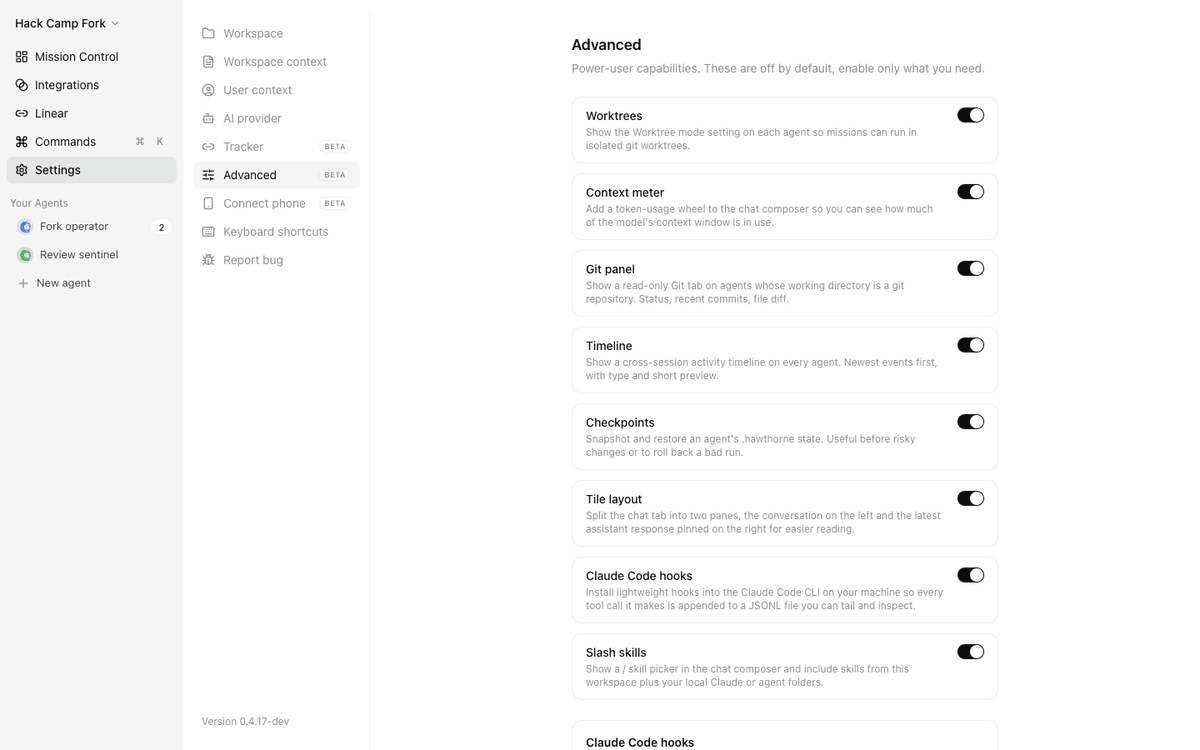
Speed creates a different danger: half-finished features leaking into the product. The answer was to build the flag platform first, then ship each capability behind its own flag — worktrees, a context meter, a git panel, a timeline, checkpoints, tile layout, Claude-Code hooks, a slash-skills catalog. Off by default, each with its own KB doc.
This is what lets an agent merge an in-progress feature to main safely: it's dark until you turn it on. The flag platform is the thing that makes "merge early, merge often" compatible with "don't break the build."
2.3 Verify by interacting, not by claiming
An agent that says "done" has proven nothing. So the whole inventory — and this post — is built on evidence captured from a running system, not from the diff.
We booted the Rust engine locally, drove the UI through the browser via the non-Tauri fallback we built, and captured real screenshots and video against a fresh dev database. The Linear board is seeded through the same on-disk projection the engine reads after OAuth sync; the Git, Timeline, Checkpoints, Advanced settings, and activity board are all live engine/UI surfaces. The mission board below — Running, Needs you, Done — is served live by the engine:
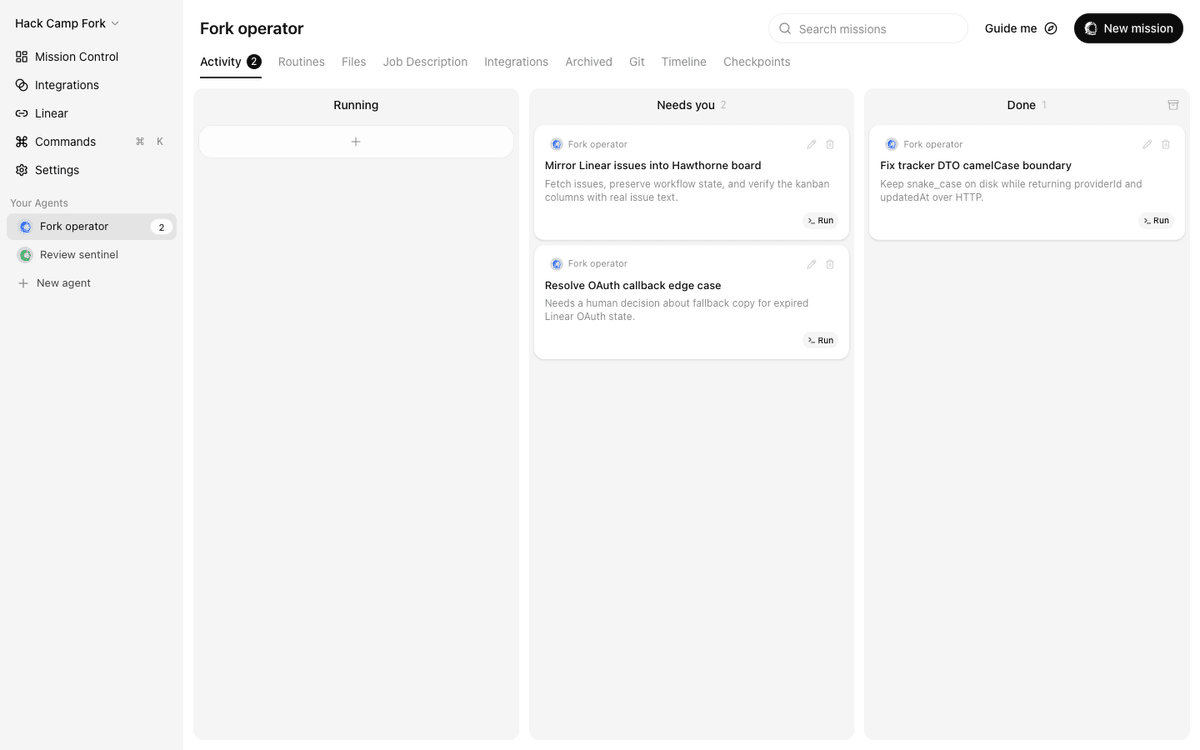
Reasoning is not validation. Interaction is. That single rule is the difference between a demo that works once and a feature you can stand behind.
2.4 Governance is what makes speed safe
The thread tying all of this together is a portable harness — bstack — that encodes the disciplines above as always-on primitives: clean-tree hygiene, parallel-worktree fanout, empirical verification, dependency-chain reasoning before any write, and a cross-model adversarial review gate before any substantive merge.
The harness is the reason the 89 commits are reviewable instead of a pile. Each one came through a PR with CI — typecheck, cargo check, tests — a daily upstream sync, Changesets, and a pre-commit hook. There's even a "No-Silent-Failures" linter that bans the patterns (let _ = fallible, .ok()-to-drop, catch-and-continue) that let errors disappear. Going fast and staying honest are not in tension when the honesty is automated.
3. What got built
The method produced real surface area. Here's the inventory, grouped by what it delivers.
3.1 Four net-new Rust crates
The engine grew from 17 to 21 crates. Four are genuinely new code, confirmed by diffing the engine trees:
houston-orchestration— the V2 brain. The fs-canonical object model (Initiative → Project → Task → Cycle → Run) grafted onto the Houston body. The filesystem is the orchestration store: a status change is a git diff.houston-linear— full Linear tracker integration. Schemas, a cynic GraphQL client, OAuth, a REST surface, webhook verification, and a mirror pipeline. 24 source files.houston-life— a Rust client to the Life runtime over a Unix socket (Stage-0 end-to-end proven), with protobuf. Bridges Life into the agent stack.houston-claude-hooks— installs and uninstalls hooks into Claude Code'ssettings.json, powering theadvanced.claude_hooksflag.
3.2 Linear integration — the largest cluster
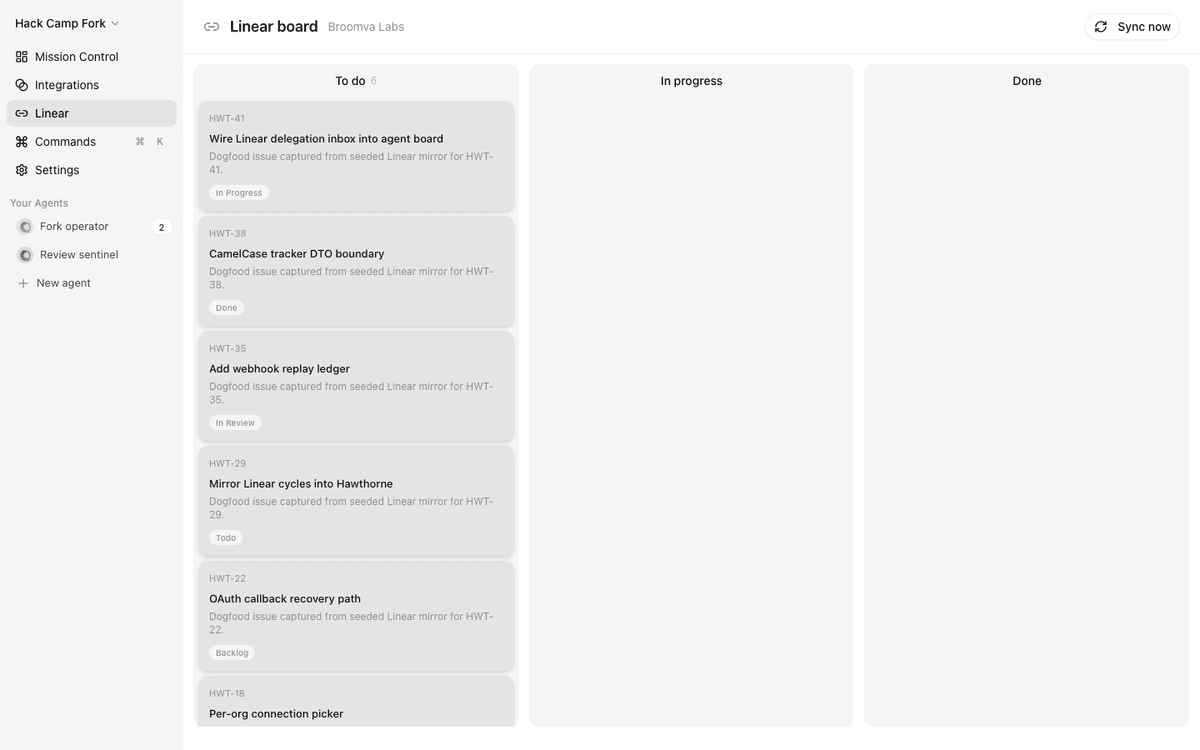
The single biggest body of work: OAuth into Linear's Agent Session protocol so an agent can read and write issues, projects, and cycles — and respond to delegations — with the whole tracker mirrored inside the shell. Webhook verification with an idempotency ledger, an inbox↔activity protocol, workspace-many connection management, and a camelCase kanban serialization fix all landed here across a dozen-plus PRs. In the dogfood pass the board rendered six mirrored issues from the running engine path, not a static mock.
3.3 The git panel
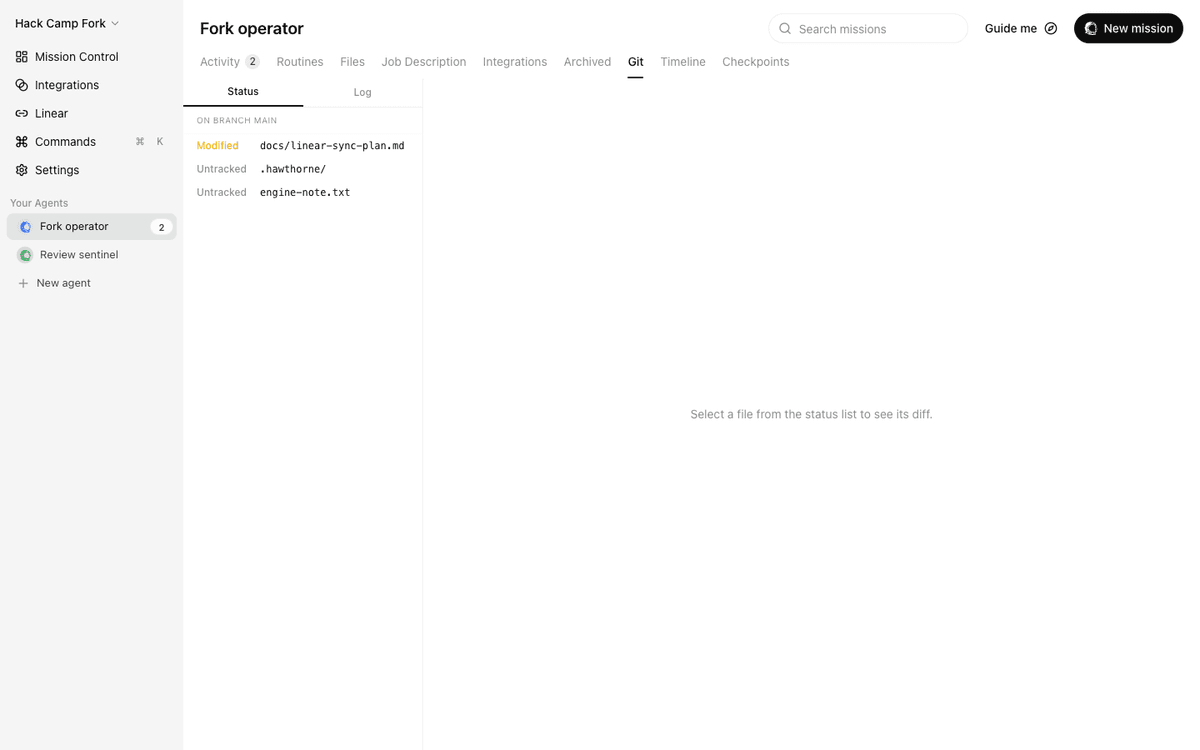
Status, log, branch, untracked files, and diffs — read live from new engine /v1/git/* routes. Because every agent run happens in a git worktree, the git panel is how you see what an agent actually changed, from frame one. (We also git init every new agent folder at boot, and added a migration that auto-fixes older agent dirs missing a .git, so the panel always has something to read.)
3.4 Checkpoints and timeline
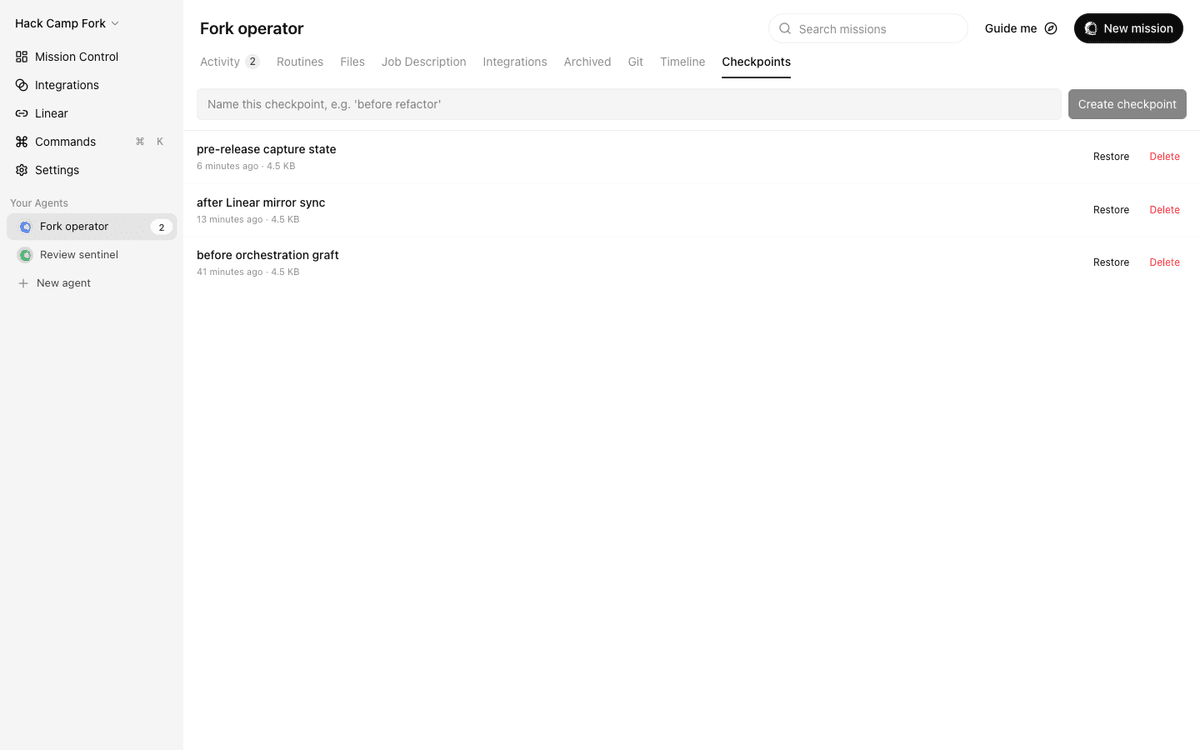
Checkpoints snapshot an agent's .houston state before a risky run, so you can restore it if a run goes sideways. Timeline is the cross-session record — every message, tool call, and result, newest first.
3.5 Push pipeline, Life bridge, and more
The rest of the 89 commits: a push/tunnel notification pipeline (a Notify frame on the engine↔relay protocol, a NotifyFrame as an APNs/FCM loc-key for device-side localization, a notify dispatcher mapping session status to notifications); a Life Runtime bridge routed through the session manager; an interactive AskUserQuestion over MCP, disallowed in headless mode; and a Capacitor mobile shell plus a native cross-review tool for second opinions.
3.6 The running fork, in motion
The additions ledger at the top of this post is the static list; this is the same fork moving. The clip below is a single unbroken capture from the running build — one pass through Activity, Linear, Git, Timeline, and Checkpoints, stitched from the same dogfood session the screenshots above came from.

Nothing in it is a mockup: the board is served by the engine, the diffs are read from real /v1/git/* routes, and the timeline replays actual tool calls. That is the whole point of §2.3 — you are looking at interaction with a running system, not a render of one. For the complete itemized inventory, see the additions ledger near the top of this post or the interactive showcase.
4. The numbers, verified against git
Every figure in this post is checked against ground truth, not estimated:
git rev-list --count houston-upstream/main..HEAD→ 89 commits aheadgit diff --shortstat houston-upstream/main...HEAD→ 1,118 files, +101,906 / −21,310- engine crate diff → 17 → 21 crates
- 6 live worktrees, all clean at snapshot time
There's also a cloud track living on feature branches, not yet in HEAD: a cloud sandbox control surface with a benchmark harness, an engine container with a Railway runbook and a public /healthz, an 11-page architecture spec set, and a hardened context-enablement pipeline.
5. What this is really about
The features are nice. The transplant — a brain that turns work into the noun and pushes orchestration off the human — is the actual bet, and it's still in progress (V2-M1, grafting the scheduler onto the body).
But if you take one thing from this, take the method. Eighty-nine reviewable commits in a hack camp is not a typing-speed story. It's a harness story. Parallel agents in isolated worktrees, every feature behind a flag, every claim backed by interaction with a running system, and a governance layer that automates the honesty — that's the combination that lets you go genuinely fast without the output being slop.
Upstream Houston watches agents run. The fork builds, on its own. The harness is what made building it safe.