This post was created by the very system it describes. One sentence in, nine phases later: a complete publishing package across broomva.tech, X, LinkedIn, and Instagram — with audio narration, video scripts, and AI-generated visuals. No SaaS. No copy-pasting. Just CLI tools and agent skills.
Here's how.
The Problem: Content as Manual Labor
Developers automate everything — CI/CD pipelines, infrastructure provisioning, testing, deployment. But when it comes to writing about their work, the workflow looks like 2010:
- Write a blog post in Google Docs or Notion
- Copy-paste it into your blog platform
- Manually rewrite it for X (shorter), LinkedIn (professional tone), Instagram (visual)
- Create images in Canva or Figma, export, upload separately
- Post to each platform one by one
- Repeat next week
No version control. No media automation. No distribution strategy. No feedback loop. The irony: we build systems that deploy code to millions of servers with a single git push, but publishing a blog post takes 3 hours of manual labor across 5 browser tabs.
The Solution: Content as Code
The /blog-post skill treats content like a software artifact — structured, version-controlled, multi-target compiled, and deployed via CLI.
Give it a sentence:
/blog-post "How to build an Agent OS in Rust" — developers, educate, provocative
Get a complete publishing package:
posts/2026-03-20-agent-os-rust/
├── README.md                    # Package manifest
├── brief.md                     # Content brief
├── outline.md                   # Structural blueprint
├── broomva-tech-post.mdx        # Long-form blog post
├── x-post.md                    # X single post (280 chars)
├── x-thread.md                  # X thread (7 tweets)
├── linkedin-post.md             # LinkedIn post
├── instagram-post.md            # Carousel spec + caption
├── instagram-reel.md            # 30s vertical video script
├── media/                       # Image prompts, audio scripts, video scripts
└── strategy/                    # Audience, distribution plan, CTA
18+ files. 7 platform surfaces. One invocation.
The 9-Phase Pipeline
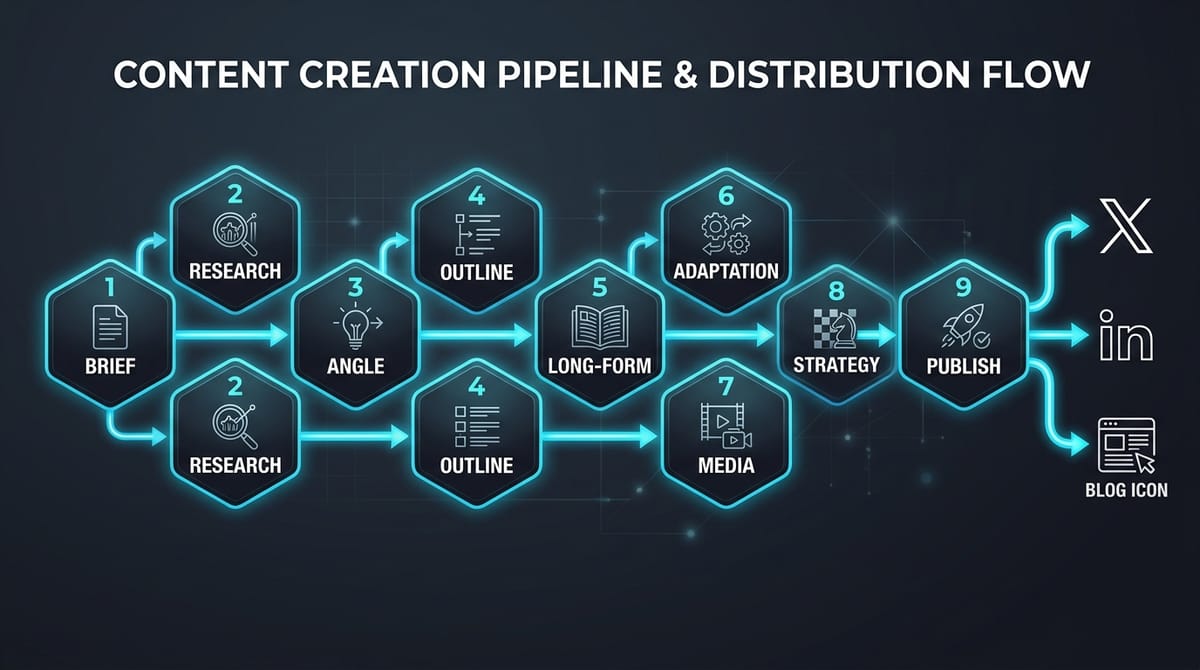
The skill runs a structured pipeline — each phase produces a concrete artifact:
| Phase | Name | Output |
|---|---|---|
| 0 | Brief Intake | brief.md — topic, audience, intent, platforms |
| 1 | Research | research.md — data, sources, claims to verify |
| 2 | Angle Selection | Storytelling framework (ABT, PSI, 1-3-1, Pixar Spine) |
| 3 | Outline | outline.md — structural blueprint with media inventory |
| 4 | Long-Form | broomva-tech-post.mdx — primary blog post |
| 5 | Adaptation | Platform-native content for X, LinkedIn, Instagram |
| 6 | Media | Image prompts, audio scripts, video compositions |
| 7 | Strategy | Audience profile, distribution plan, CTA alignment |
| 8 | Publish | Automated posting via xurl, curl, and git |
The key insight: each platform gets native content, not a copy-paste resize. An X thread is a beat-by-beat narrative. A LinkedIn post leads with a professional hook. An Instagram carousel is visual-first. Same message, different expression.
The Stack Behind It
The /blog-post skill doesn't work alone — it orchestrates a constellation of compounding skills from the Broomva Stack:
| Skill | What It Contributes |
|---|---|
/content-creation |
Storytelling frameworks (ABT, PSI, Pixar Spine), social distribution patterns, AI asset generation |
/deep-research |
Multi-source research with citation tracking |
/pencil |
Design carousel slides, social cards, diagrams |
/remotion-best-practices |
Video composition with spring animations |
/arcan-glass |
Broomva dark-first brand styling |
/prompt-library |
Reusable prompts for content generation |
/bstack |
27 skills across 7 layers — the full governance and skill stack |
The bstack architecture has 7 layers: Foundation, Memory, Orchestration, Research, Design, Platform, and Strategy. The /blog-post skill sits in the Platform layer and reaches into all the others.
Platform-Native Distribution
Publishing uses only native CLI tools and REST APIs — no Ayrshare, no Buffer, no third-party services.
| Platform | Tool | How |
|---|---|---|
| X | xurl CLI |
xurl post "text" --media hero.png for posts, reply chains for threads |
curl |
Posts API v2 (/v2/posts) with OAuth2 bearer token |
|
curl |
Instagram Business Login API via graph.instagram.com |
|
| broomva.tech | git + gh |
Copy .mdx + assets, create PR |
The publish.sh script reads a content package and posts to all configured platforms:
./scripts/publish.sh /broomva/posts/2026-03-20-my-post --platform all
📦 Publishing content package: 2026-03-20-my-post

📋 Platform Status:
  ✅ X (xurl)
  ✅ LinkedIn
  ✅ Instagram
  ✅ broomva.tech (git)
All credentials stored locally in ~/.config/blog-post/ — never in a repo, never in a SaaS dashboard. The conversation bridge PII scrubber catches any accidental credential exposure across 7 pattern categories.
The Meta Proof
This section was generated by Phase 4 of the pipeline. The X thread you'll see on @broomva_tech was generated by Phase 5. The hero image was prompted by Phase 6. The distribution plan was generated by Phase 7.
You're reading the output of Phase 8.
The content package for this very post lives at:
/broomva/posts/2026-03-20-how-to-create-a-blog-post-with-bstack/
28 files. Created in a single Claude Code session. Validated by quick_validate.py. Published by publish.sh.
The best documentation is the artifact itself.
Try It Yourself
Install the skill:
npx skills add broomva/blog-post --yes
Create your first content package:
/blog-post "your topic here" — your audience, your intent, your tone
Set up platform connectors (one-time):
# X (Twitter)
xurl auth apps add myapp --client-id YOUR_ID --client-secret YOUR_SECRET
xurl auth oauth2

# LinkedIn
# Follow the OAuth2 flow in references/publishing-automation.md

# Instagram
# Follow the Business Login flow in references/publishing-automation.md
Publish:
./scripts/publish.sh /broomva/posts/YYYY-MM-DD-slug --platform all
The skill, the stack, and this post are all open source:
- Skill: github.com/broomva/blog-post
- Stack: github.com/broomva/workspace
The best documentation is the artifact itself. This post exists because a skill created it. The skill exists because a stack made it possible. The stack exists because agents deserve infrastructure, not just prompts.