A single cargo install broomva now gives you the entire Broomva stack: CLI commands, a monitoring daemon, and 24 agent skills. No Node runtime. No package manager dance. One binary.
The problem with the old CLI
The original @broomva/cli was a TypeScript package distributed via npm. It worked, but it carried baggage:
- Runtime dependency: users needed Node.js or Bun installed
- Cold start overhead: every invocation loaded a JS runtime
- Misaligned with the core stack: the Agent OS infrastructure (Symphony, Arcan, Lago, Autonomic) is Rust — the CLI was the odd one out
- Daemon limitations:
setInterval+clearIntervalis not how you build a production monitoring daemon
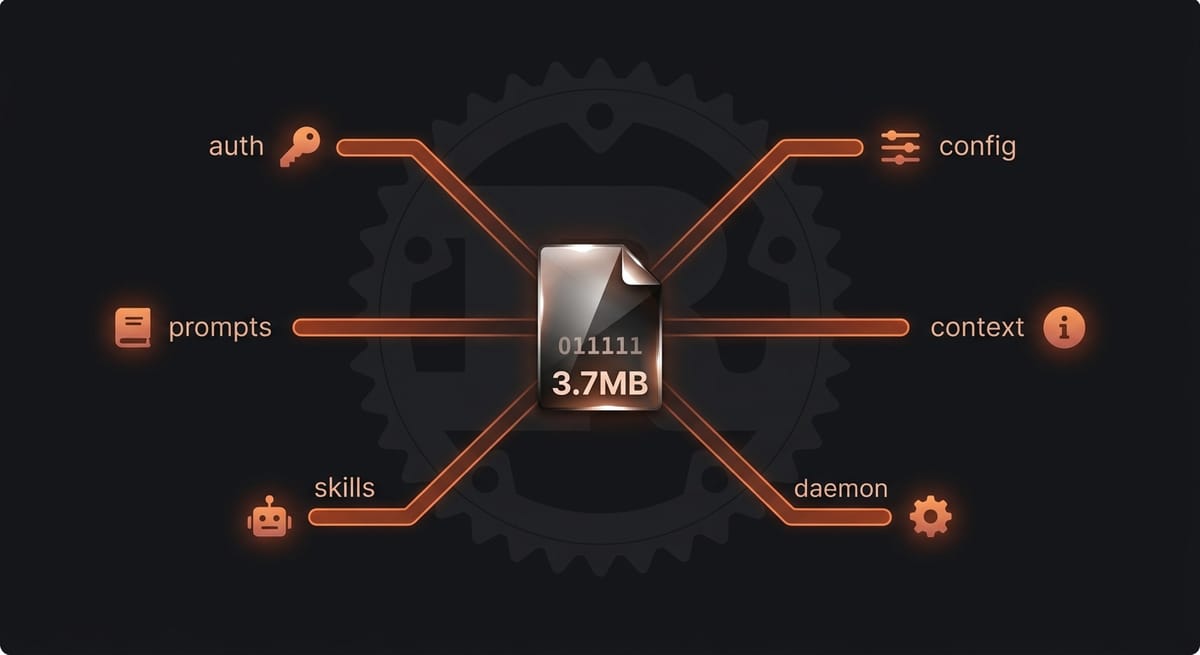
The Rust rewrite solves all of these. The binary is 3.7MB stripped, starts instantly, and follows the exact same patterns as Symphony — clap, reqwest, axum, thiserror, tokio.
What the CLI does
broomva auth login          # Device code OAuth (opens browser)
broomva prompts list        # Browse prompt library
broomva prompts pull <slug> # Download prompt with frontmatter
broomva skills list         # Browse 24 bstack skills
broomva context show        # Project conventions & stack info
broomva daemon start        # Infrastructure monitoring
Six command groups covering the full broomva.tech API surface: auth, prompts, skills, context, config, and daemon.
Backward compatibility by design
The TS CLI writes ~/.broomva/config.json with camelCase keys. Users have tokens stored there. Ripping that out would break existing setups.
The fix is one line of Rust:
#[derive(Serialize, Deserialize)]
#[serde(rename_all = "camelCase")]
pub struct CliConfig {
    pub token: Option<String>,
    pub token_expires_at: Option<String>,
    pub api_base: Option<String>,
    // ...
}
token_expires_at in Rust maps to tokenExpiresAt in JSON — identical to what the TS CLI produces. Both CLIs read and write the same config file. Zero migration needed.
The daemon: async Rust done right
The daemon runs a heartbeat loop that polls three sensors (site health, API health, Railway services) on a configurable interval. The TS version used setInterval. The Rust version uses tokio::select! with a CancellationToken:
pub async fn run(&self) {
    let mut interval = tokio::time::interval(
        Duration::from_millis(self.interval_ms)
    );
    loop {
        tokio::select! {
            _ = interval.tick() => self.tick().await,
            _ = self.cancel.cancelled() => break,
        }
    }
}
Clean cancellation, proper signal handling (SIGTERM via PID file), shared state via Arc<RwLock<HeartbeatState>> between the heartbeat loop and the Axum dashboard server.
The dashboard runs on port 7890 and serves a live HTML page showing sensor status, latency, and tick count — plus JSON endpoints at /api/health and /api/symphony for programmatic consumption.
Environment targeting
The daemon supports two modes:
| Flag | broomva.tech | Symphony | Arcan | Lago | Autonomic |
|---|---|---|---|---|---|
--env railway |
broomva.tech | config URL | config URL | config URL | config URL |
--env local |
localhost:3000 | localhost:8080 | :8081 | :8082 | :8083 |
Individual --symphony-url, --arcan-url, etc. overrides take precedence in both modes. This means you can test against local Symphony while pointing at production broomva.tech.
One install command
The real power move is the installer. One curl command installs everything:
curl -fsSL https://broomva.tech/api/install | bash
This does three things:
- Installs the broomva binary via
cargo install(or downloads a pre-built binary as fallback) - Installs the broomva.tech skill for Claude Code / agent workflows
- Bootstraps bstack — all 24 Broomva Stack skills across 7 layers
The full stack, from CLI to skills to monitoring, from a single command.
Architecture decisions
A few choices that kept the project simple:
- Single crate, not a workspace: Symphony needs 8 internal library crates because it has complex domain logic. The CLI has four concerns (parsing, API client, config, daemon) — modules within one crate suffice
- No dependency on symphony-core or aios-protocol: the CLI is a pure HTTP client. Adding gRPC and protobuf for zero benefit would be engineering theater
thiserrorfor the library,anyhowfor main: clean error types where they matter, ergonomic error handling at the top level- Native async fn in trait via
Pin<Box<dyn Future>>: noasync_traitcrate needed on Rust 1.88+
The numbers
| Metric | Value |
|---|---|
| Source files | 34 |
| Lines of Rust | 5,914 |
| Binary size (release, stripped) | 3.7 MB |
| Dependencies | 17 direct |
| Tests | 5 (config serialization, frontmatter roundtrip, CLI parsing) |
| Clippy warnings | 0 |
| Time from plan to crates.io | Same session |
What comes next
The CLI is a client. It doesn't participate in event envelopes, journal writes, or the aios-protocol contract — yet. As the Agent OS stack matures, the CLI becomes the primary interface for operators:
broomva daemon startbecomes the entry point for edge monitoringbroomva prompts pushfeeds the prompt library from any machinebroomva skills installprovisions agent capabilities in one command
The binary is on crates.io. The source is in the broomva.tech monorepo. Install it and see what 3.7MB can do.
cargo install broomva