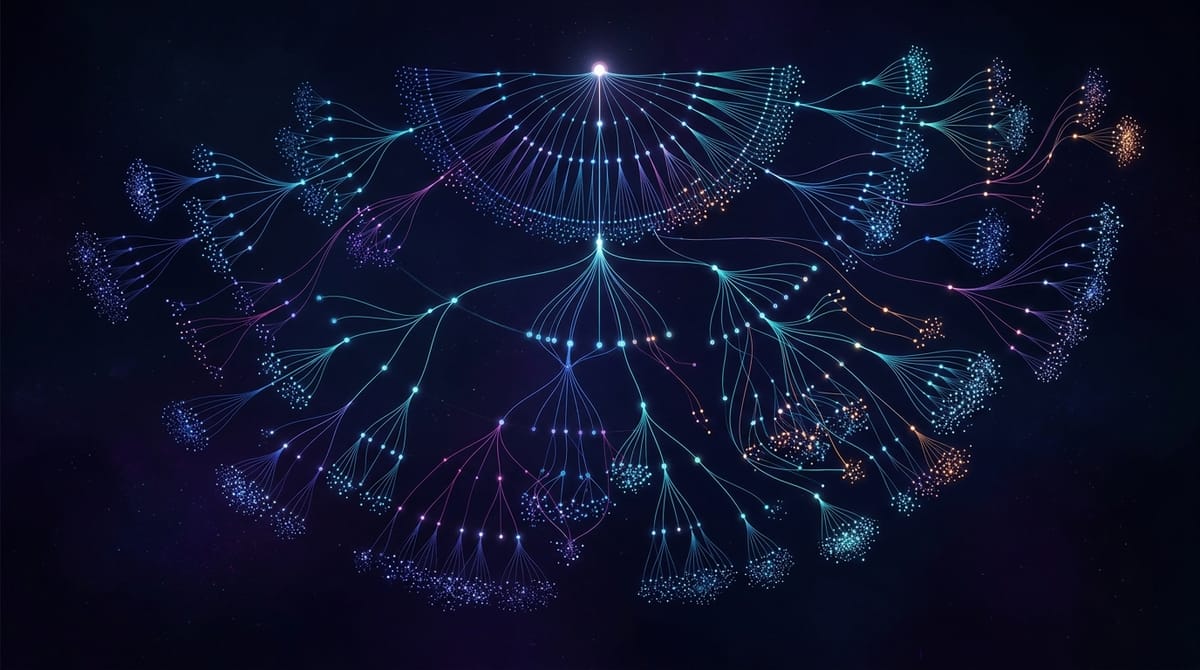
Some problems are too hard for a single agent. A sorting bug might have one fix. A system redesign might have dozens of viable approaches — and the best one emerges only when multiple agents explore the space simultaneously and learn from each other.
That's what Hive Mode does. It turns Symphony from a single-agent orchestrator into a multi-agent evolutionary system where N agents compete and cooperate across generations, each running EGRI (Evaluator-Governed Recursive Improvement) loops, coordinating through real-time Spaces channels, with all state persisted to an append-only Lago journal.
How it works
Label an issue hive in your tracker. Symphony does the rest.
# WORKFLOW.md
hive:
  enabled: true
  agents_per_task: 3
  max_generations: 5
  convergence_threshold: 0.01
  egri_budget_per_agent: 10
  eval_script: ./eval/eval.sh
  spaces_server_id: 1
The loop is simple:
- Generation 0 — Symphony dispatches 3 agents to the same issue. Each gets the original prompt and runs an independent EGRI loop
- Scoring — Each agent reports its best score via a real-time Spaces channel
- Selection — The coordinator picks the generation winner by highest score
- Cross-pollination — Winner's artifact + peer summaries are injected into the next generation's prompt
- Convergence check — If score improvement drops below threshold, or max generations reached, the task completes
Issues without the hive label use the existing single-agent dispatch path. Zero changes to that flow.
The numbers
| Metric | Value |
|---|---|
| Crates touched | 5 (aios-protocol, lago-core, arcan-spaces, autoany-core, symphony) |
| New event types | 5 (HiveTaskCreated → HiveTaskCompleted) |
| New Rust files | 4 (hive.rs in each crate) |
| Tests added | 40+ across all crates |
| Breaking changes | 0 |
| New dependencies | 0 |
The architecture
Hive Mode is not a separate system. It's a dispatch strategy composed from four existing primitives:
EGRI (autoany) provides the evaluator-governed improvement loop. Each agent runs bounded trials with automatic rollback, constraint checking, and promotion.
Spaces provides real-time inter-agent communication. Agents publish scored artifacts to a shared channel, threads separate generations, and the coordinator reads all results for selection.
Lago provides the persistence substrate. Every hive event — task creation, artifact sharing, selection, generation completion — is an immutable event in the append-only journal. The full history is replayable.
Symphony provides the orchestration. The HiveCoordinator manages the generation loop, and the dispatch system knows that hive issues can have multiple concurrent agents per task.
┌─────────────────────────────────────────────────────────────┐
│ Symphony Orchestrator                                        │
│  ┌─────────────────┐                                         │
│  │ HiveCoordinator │ ← convergence check, generation loop    │
│  └────────┬────────┘                                         │
│           │ dispatches N agents per generation                │
│  ┌────────┴────────────────────────────────────────────┐     │
│  │  Agent 0          Agent 1          Agent 2          │     │
│  │  ┌──────────┐    ┌──────────┐    ┌──────────┐      │     │
│  │  │ EGRI     │    │ EGRI     │    │ EGRI     │      │     │
│  │  │ Loop     │    │ Loop     │    │ Loop     │      │     │
│  │  └────┬─────┘    └────┬─────┘    └────┬─────┘      │     │
│  │       │               │               │             │     │
│  │       └───────────────┼───────────────┘             │     │
│  │                       ▼                             │     │
│  │              Spaces Channel                         │     │
│  │         (artifacts + scores)                        │     │
│  └─────────────────────────────────────────────────────┘     │
│                       │                                      │
│                       ▼                                      │
│              Lago Event Journal                              │
│         (immutable, replayable)                              │
└─────────────────────────────────────────────────────────────┘
Deep dive: the event protocol
Hive Mode introduces 5 typed event variants to the aios-protocol kernel contract. They're proper enum variants, not Custom JSON blobs — which means pattern matching, compile-time checks, and zero runtime parsing overhead.
// aios-protocol/src/event.rs

HiveTaskCreated {
    hive_task_id: HiveTaskId,
    objective: String,
    agent_count: u32,
},
HiveArtifactShared {
    hive_task_id: HiveTaskId,
    source_session_id: SessionId,
    score: f32,
    mutation_summary: String,
},
HiveSelectionMade {
    hive_task_id: HiveTaskId,
    winning_session_id: SessionId,
    winning_score: f32,
    generation: u32,
},
HiveGenerationCompleted {
    hive_task_id: HiveTaskId,
    generation: u32,
    best_score: f32,
    agent_results: serde_json::Value,
},
HiveTaskCompleted {
    hive_task_id: HiveTaskId,
    total_generations: u32,
    total_trials: u32,
    final_score: f32,
},
Each event is serde-roundtrippable and carries enough context to reconstruct the full hive state from the journal.
Deep dive: the HiveTask aggregate
On the Lago side, the HiveTask aggregate rebuilds the full task state from events — no mutable database, just a fold:
// lago-core/src/hive.rs

pub struct HiveTask {
    pub hive_task_id: HiveTaskId,
    pub objective: String,
    pub agent_sessions: Vec<SessionId>,
    pub current_generation: u32,
    pub best_score: Option<f32>,
    pub best_session_id: Option<SessionId>,
    pub completed: bool,
}

impl HiveTask {
    pub fn from_events(events: &[EventEnvelope]) -> Option<Self> {
        // Fold over HiveTaskCreated → HiveArtifactShared →
        // HiveSelectionMade → HiveTaskCompleted
    }
}
Because Lago is append-only, you can replay any hive task at any point in time. Debug a generation that ran three days ago? Query the events, fold, inspect.
Deep dive: real-time coordination through Spaces
Agents don't poll. They publish and subscribe through Spaces, a distributed communication layer built on SpacetimeDB. The HiveSpacesCoordinator wraps the Spaces port with hive-specific conventions:
// arcan-spaces/src/hive.rs

pub struct HiveSpacesCoordinator {
    spaces: Arc<dyn SpacesPort>,
    server_id: u64,
}

impl HiveSpacesCoordinator {
    pub fn share_artifact(&self, channel_id: u64, generation: u32,
        hive_task_id: &str, session_id: &str,
        score: f32, tldr: &str) -> Result<SpacesMessage>;

    pub fn read_generation_artifacts(&self, channel_id: u64,
        generation: u32) -> Result<Vec<HiveArtifactMessage>>;

    pub fn announce_selection(&self, channel_id: u64, generation: u32,
        hive_task_id: &str, winning_session_id: &str,
        winning_score: f32) -> Result<SpacesMessage>;

    pub fn read_hive_context(&self, channel_id: u64)
        -> Result<HiveContext>;
}
One channel per hive task. Threads separate generations (thread_id = generation number). Messages are JSON with a hive_event discriminator — "artifact_shared", "selection_made", "claim", "skill". No custom WASM module deployment needed.
Deep dive: EGRI cross-pollination
The real leverage comes from inter-agent learning. After each generation, the winning agent's trial history is injected into the next generation's EGRI loops:
// autoany-core/src/loop_engine.rs

impl<A, M, E> EgriLoop<A, M, E> {
    /// Current best score for hive reporting.
    pub fn best_score(&self) -> Option<&Score> {
        self.best_outcome.as_ref().map(|o| &o.score)
    }

    /// Inject trial records from another agent's history.
    /// Records are appended to the ledger for the proposer
    /// to learn from, but don't affect promotion state.
    pub fn inject_history(&mut self, records: Vec<TrialRecord>) -> Result<()> {
        for record in records {
            self.ledger.append(record)?;
        }
        Ok(())
    }
}
And on the Lago adapter side, merged ledgers are reconstructed from hive-scoped events:
// autoany-lago/src/replay.rs

pub fn replay_hive_history(
    events: &[serde_json::Value],
    hive_task_id: &str,
) -> Result<Ledger> {
    // Filters by metadata hive_task_id and "egri." event prefix
    // Reconstructs merged ledger from all agents' trials
}
The proposer in generation N+1 sees what worked in generation N — across all agents. It learns from peers without explicit coordination.
Deep dive: the coordinator
The HiveCoordinator manages the evolutionary loop. Convergence is a simple delta check:
// symphony-orchestrator/src/hive.rs

pub struct HiveCoordinator {
    pub hive_task_id: String,
    pub issue: Issue,
    pub config: HiveConfig,
    pub agent_sessions: Vec<HiveAgentSession>,
    pub current_generation: u32,
    pub best_global_score: f32,
    previous_best_score: f32,
}

impl HiveCoordinator {
    pub fn should_continue(&self) -> bool {
        if self.current_generation >= self.config.max_generations {
            return false;
        }
        if self.current_generation > 0 {
            let improvement =
                (self.best_global_score - self.previous_best_score).abs() as f64;
            if improvement < self.config.convergence_threshold {
                return false;
            }
        }
        true
    }
}
The dispatch system knows that hive issues are special — multiple agents can run for the same issue, keyed by {issue_id}:hive-{n}. A separate eligibility function counts running hive agents instead of blocking on running.contains_key:
// symphony-orchestrator/src/dispatch.rs

pub fn is_hive_dispatch_eligible(
    issue: &Issue,
    state: &OrchestratorState,
    terminal_states: &[String],
    active_states: &[String],
    per_state_limits: &HashMap<String, u32>,
    hive_config: &HiveConfig,
) -> bool {
    // ...same checks as single-agent EXCEPT:
    let hive_prefix = format!("{}:hive-", issue.id);
    let running_for_issue = state.running.keys()
        .filter(|k| k.starts_with(&hive_prefix))
        .count() as u32;
    if running_for_issue >= hive_config.agents_per_task {
        return false;
    }
    // ...
}
Deep dive: prompt injection
Each hive agent receives context about its role, generation, previous winner, and peer approaches:
// symphony-arcan/src/runner.rs

pub struct HiveSessionContext {
    pub hive_task_id: String,
    pub generation: u32,
    pub agent_index: u32,
    pub previous_winner_artifact: Option<String>,
    pub previous_trial_summary: Option<String>,
    pub peer_summaries: Vec<String>,
}
The prompt gets a ## Hive Context prefix:
## Hive Context
You are agent 1 of 3 working on this task. Generation: 2.
### Previous Best (score: 0.870)
def solve(): return 42
### Peer Approaches
- tried brute force
- tried dynamic programming
### Directive
Build on the previous best. Try a different approach from peers.
---
Fix the sorting bug in sort.py
Session IDs encode the full lineage: hive-{task_id}-gen{g}-agent{n}. Metadata tags (hive_task_id, generation, agent_index) are attached to the Arcan session for queryability.
What EventQuery filtering enables
Lago's EventQuery was extended with metadata and kind filters — critical infrastructure for hive queries:
// lago-core/src/journal.rs

pub struct EventQuery {
    // ...existing fields...
    pub metadata_filters: Option<Vec<(String, String)>>,
    pub kind_filter: Option<Vec<String>>,
}

impl EventQuery {
    pub fn with_metadata(mut self, key: impl Into<String>,
        value: impl Into<String>) -> Self;
    pub fn with_kind(mut self, kind_name: impl Into<String>) -> Self;
}
Query all artifacts for a specific hive task:
EventQuery::new()
    .with_metadata("hive_task_id", "H-42")
    .with_kind("HiveArtifactShared")
Post-deserialization filtering keeps it simple — hive queries are always scoped to a session, so no full-scan concern.
What this enables
Harder problems: System redesigns, performance optimization, refactoring strategies — problems where the solution space is wide and the optimal path isn't obvious.
Exploration at scale: 3 agents × 5 generations × 10 EGRI trials = 150 evaluated approaches. The best one wins.
Full auditability: Every trial, every score, every selection is an immutable Lago event. Replay any hive task to understand why a particular solution won.
Real-time coordination: Agents don't work in isolation. Spaces channels give them a shared communication fabric — claims prevent duplicate work, skills propagate discoveries.
Convergence-driven termination: No wasted compute. When improvement stalls, the loop stops.
Zero friction: It's just a YAML flag and an issue label. Everything else is automatic.
The stack
| Layer | Component | Role |
|---|---|---|
| Protocol | aios-protocol |
5 typed event variants + HiveTaskId |
| Persistence | lago-core |
Event journal with metadata/kind query filters + HiveTask aggregate |
| Coordination | arcan-spaces |
Real-time pub/sub with JSON message convention |
| Improvement | autoany-core |
EGRI loop with inject_history + best_score |
| Orchestration | symphony-orchestrator |
HiveCoordinator, dispatch eligibility, generation loop |
| Runtime | symphony-arcan |
Session context injection, metadata propagation |
All Rust. All tested. All wired through existing infrastructure.
# Enable hive mode in any Symphony project
symphony init
# Edit WORKFLOW.md: set hive.enabled: true
# Label an issue "hive" in your tracker
# Start Symphony
symphony run --daemon