
For the first time in human history, the cost of building something useful is collapsing toward zero. Not declining gradually the way transistor prices did over decades — collapsing, suddenly, in the span of months. A person with a laptop and an LLM can now produce in an afternoon what took a team of engineers a quarter. An agent can deploy, configure, monitor, and heal a production system without ever asking for permission.
This is not a productivity improvement. It is a phase transition. And it breaks most of what we know about how to build a business around software.
The Death of Shovels and Pickaxes

Every technology gold rush summons the same parable: don't mine for gold, sell shovels and pickaxes. During the California Gold Rush, this worked. Levi Strauss sold jeans. Samuel Brannan sold pans. They made fortunes while most miners went broke.
The analogy became Silicon Valley gospel. Don't build apps — build the platform. Don't chase users — sell the tools. AWS, Stripe, Twilio, Shopify — all shovels-and-pickaxes businesses. They abstracted hard problems into APIs and charged monthly for the privilege of not thinking about infrastructure.
But there is a premise buried in the analogy that no one examines: shovels were scarce. They were physical objects. You could not copy a pickaxe by looking at it. Manufacturing required capital, materials, and distribution. Scarcity was built into the product.
Software shovels have no such constraint. Code is infinitely reproducible. Deployment is automated. Configuration is a conversation with an LLM. The shovel can not only copy itself — it can dig the mine, assay the gold, and build the next shovel while you sleep.
When shovels replicate themselves, selling shovels is not a business. It is a race to zero.
The SaaS Endgame

The entire SaaS industry was built on a single bargain: we will run this thing so you do not have to. Databases, email servers, CI pipelines, monitoring dashboards, analytics platforms — all predicated on the assumption that operating software is hard enough that people will pay a monthly fee to avoid it.
This bargain is dissolving. Not because the software got simpler, but because the operator got smarter. When an AI agent can provision infrastructure, configure a database, wire up monitoring, handle failovers, and rotate secrets — all by reading documentation and writing code — the "we manage it for you" value proposition evaporates.
Consider: a developer today can describe what they want in natural language and have an agent scaffold the project, choose the stack, write the code, deploy it to three regions, set up CI/CD, add error tracking, and open a PR for review. The entire SaaS value chain — from Heroku to Datadog to PagerDuty — compressed into a single conversation.
This does not mean these companies disappear overnight. Inertia is real. Enterprise contracts are sticky. But the floor is falling out. The new entrant does not need to match the incumbent feature-for-feature. They just need an agent that can assemble the equivalent from open-source components in twenty minutes. And that agent is getting better every week.
The Unprecedented Moment

We need to pause and acknowledge what is happening. In the entire arc of human civilization — from cave paintings to cathedrals, from the printing press to the internet — there has never been a moment where the average person could build whatever they imagined with this little friction.
A teenager in Bogotá can build a SaaS product that would have required a Series A and a team of fifteen in 2020. A retired teacher can automate their entire small business. A researcher can build custom tooling that used to require a software team embedded in their lab.
The barriers were always capital, knowledge, and time. Capital to hire engineers. Knowledge of programming languages, frameworks, infrastructure. Time to learn, iterate, debug, deploy.
AI has not lowered these barriers. It has removed them. Not reduced — removed. The teenager does not need to learn React. The teacher does not need to understand databases. The researcher does not need to file a ticket with IT. They describe what they want, and it exists.
This is liberation on a scale we have not seen since the printing press democratized knowledge. But it creates a paradox that the printing press did not face: if everyone can build, what is the value of building?
What Can't Be Copied
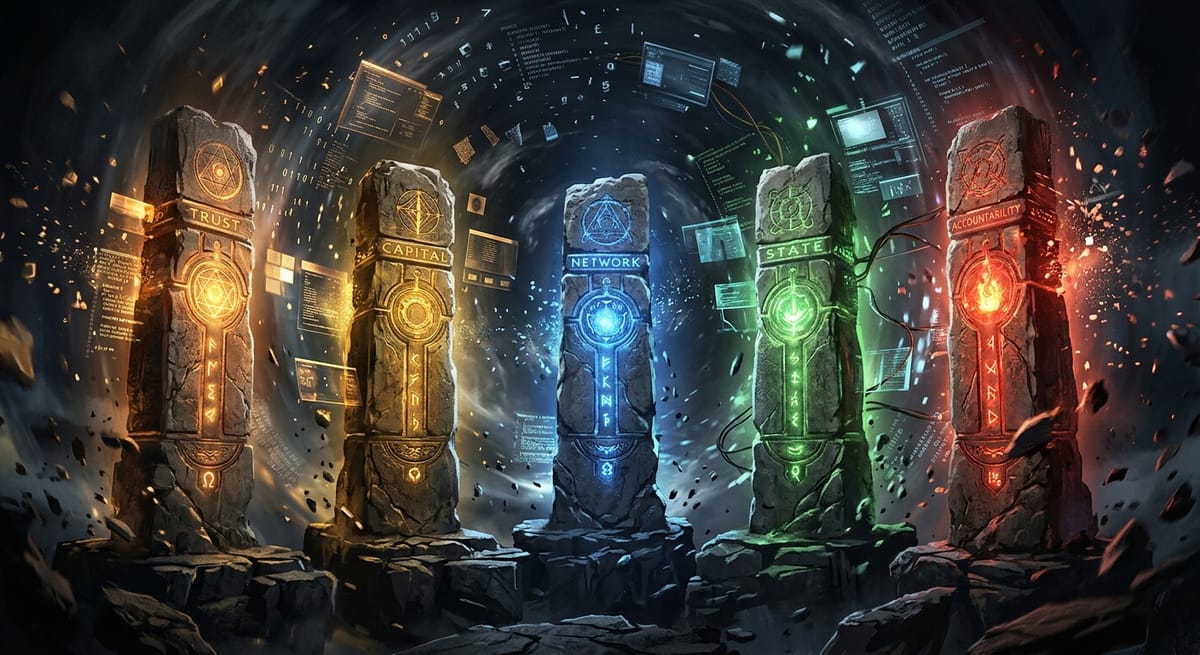
When the act of creation becomes free, the traditional sources of value — proprietary code, technical complexity, operational know-how — become worthless. If an agent can read your documentation and recreate your product in an afternoon, your product is not a moat. It is a tutorial.
So what remains scarce in a world of infinite builders?
Trust. You can clone a codebase, but you cannot clone a reputation. When autonomous agents start transacting on behalf of humans — spending money, signing contracts, accessing sensitive data — someone needs to vouch for them. Who certifies that this agent is safe? Who scores its reliability? Trust is the one thing that takes time to accumulate and cannot be accelerated by throwing compute at it. Trust requires a track record, and a track record requires history.
Capital. You can fork a payment protocol, but you cannot fork the money in the account. Financial infrastructure — clearing, settlement, lending, insurance — requires actual capital reserves. No amount of open-source code puts money in the bank. The protocol is the plumbing; the capital is the water.
Network density. A protocol for agents to discover and hire each other is worthless at N=1. It is valuable at N=10,000. Network effects are the oldest moat in technology, and they apply with even more force in the agent economy. Agents need to find each other, evaluate each other, and transact with each other. The marketplace where this happens accrues value with every participant.
Accumulated state. A blank database is just a schema. A database with ten million agent operations, reputation scores, failure patterns, and transaction histories is an oracle. The canonical record of what happened — who did what, how reliably, at what cost — cannot be bootstrapped from a GitHub repository. It can only be accumulated over time.
Accountability. When an autonomous agent makes a mistake — sends money to the wrong address, leaks private data, makes a bad trade — someone needs to be accountable. Someone needs to absorb the loss, make the counterparty whole, and ensure it does not happen again. Liability requires a legal entity, capital reserves, and the willingness to be on the hook. You cannot open-source accountability.
The New Titans

Look at which businesses survived the original Gold Rush with lasting wealth. It was not the pan sellers. It was Wells Fargo (banking and trust), the land registries (canonical state), and the railroads (network infrastructure). They did not sell tools to miners. They built systems that could not be replicated by an individual — systems that required capital, trust, network effects, and time.
The pattern repeats. The winners of the agent economy will not sell developer tools. They will not sell hosted infrastructure. They will not sell SaaS dashboards.
They will be the credit bureaus — evaluating and certifying agents the way Moody's rates bonds. They will be the central banks — providing liquidity, settlement, and financial guarantees for machine-to-machine transactions. They will be the exchanges — matching buyers with sellers in a marketplace where the participants are autonomous software. They will be the insurers — underwriting the risk of autonomous behavior with real capital behind the guarantee.
These are not software businesses. They are institutional businesses that happen to run on software. The distinction matters because software can be copied; institutions cannot.
The Open-Source Paradox

This creates a counterintuitive strategy: the more you open-source, the more defensible you become. Not less.
If your code is proprietary, someone will build an equivalent. An agent will read your API documentation, reverse-engineer the behavior, and produce an open-source alternative in a weekend. Proprietary software in the age of AI agents is not a moat — it is a countdown timer.
But if you open-source the protocol and build the institution around it, you achieve something no competitor can replicate. You set the standard. Adoption flows to you because every implementation is compatible with your ecosystem. And the institutional layers — the trust scores, the capital pool, the network graph, the canonical history — compound with every user while remaining impossible to fork.
This is the Visa model. The card network's value is not in the plastic or the payment protocol. It is in the settlement infrastructure, the fraud models trained on billions of transactions, the merchant network, and the institutional trust accumulated over decades. You could open-source every line of Visa's code tomorrow, and it would not matter. The moat was never the code.
The Question for Builders
If you are building something today, ask yourself: what happens when an agent can recreate my product by reading my landing page?
If the answer is "I lose my business," you are building a tool. Tools are a race to zero.
If the answer is "they can recreate the software but not the trust, the data, the network, or the capital behind it," you are building an institution. Institutions compound.
The marginal cost of software is approaching zero. The marginal cost of trust is not. The marginal cost of capital is not. The marginal cost of network effects is not. The marginal cost of accountability is not.
Build the things that cannot be compiled.

The Human Question

There is a deeper question beneath the economics, and it is worth sitting with: if everyone can build anything, what is the role of the builder?
For decades, "I can code" was an identity. It was a skill that separated the technical from the non-technical, the builders from the consumers. That distinction is evaporating. When a product manager can ship features without engineering, when a designer can build full-stack applications, when a student can deploy distributed systems — the act of coding is no longer a differentiator.
This is not a loss. It is an emancipation. The value was never in the typing. It was in the thinking — in knowing what to build, why it matters, and for whom. The architect is not the one who lays bricks. The architect is the one who decides what the building should be.
We are entering an era where human judgment, taste, and vision become the scarcest inputs. Not because AI cannot reason — it can. But because the question of what is worth building, what is worth trusting, and what is worth guaranteeing is fundamentally a human question. It requires values, not just capabilities.
The most valuable person in the room is no longer the one who can build the fastest. It is the one who knows what should exist.
Coda

The Gold Rush made California. Not because of the gold — most of it was gone within a decade. Because the rush attracted people, capital, and institutions that outlasted the resource they came for. San Francisco was not built by miners. It was built by bankers, lawyers, merchants, and civic leaders who realized that the real opportunity was not in the ground.
The AI rush will be the same. The gold — the ability to build software — will become so abundant as to be worthless. But the rush will attract the institutions, networks, and trust systems that the agent economy needs to function. Those will outlast the technology that created them.
The question is not what to sell. The question is what to become.