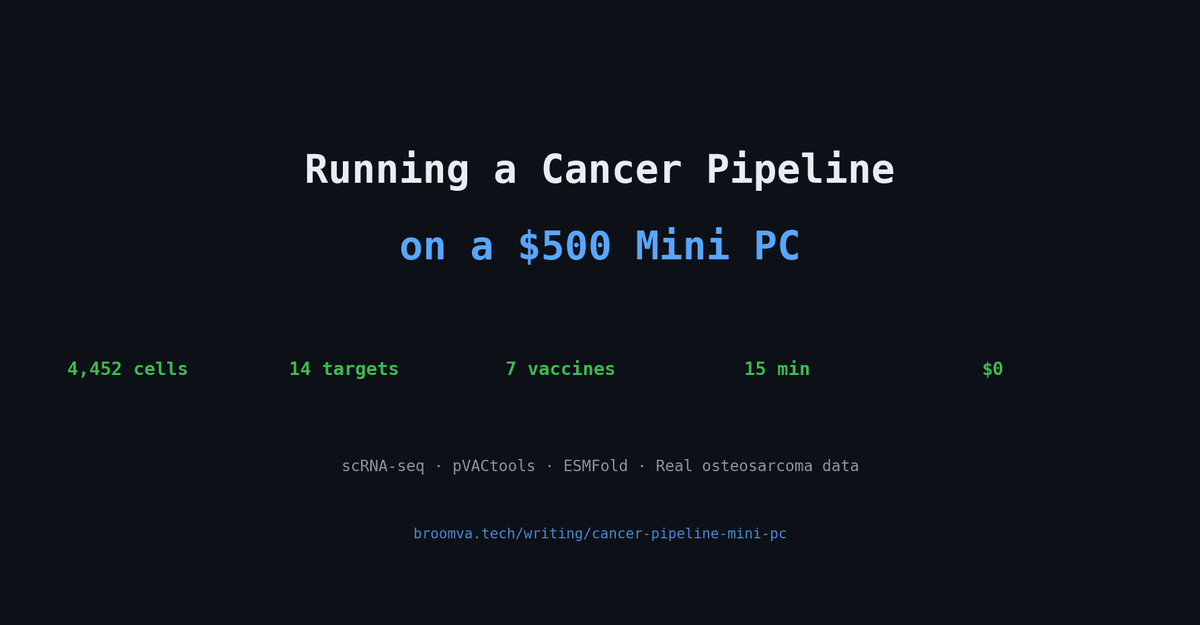
Last week we compiled every detail of Sid Sijbrandij's fight against osteosarcoma into a research repo and an agent skill. Yesterday we ran the actual pipeline on his actual data.
The hardware: an Intel NUC with an RTX 3060 sitting under a desk, accessed over Tailscale SSH from a MacBook.
The data: 1.29 GB downloaded from Sid's publicly available 25 TB dataset on Google Cloud.
The result: FAP overexpression confirmed in 15 minutes. The same finding that took a dedicated care team and 10x Genomics expertise to discover — reproduced on commodity hardware with open-source tools.
Cost: $0.
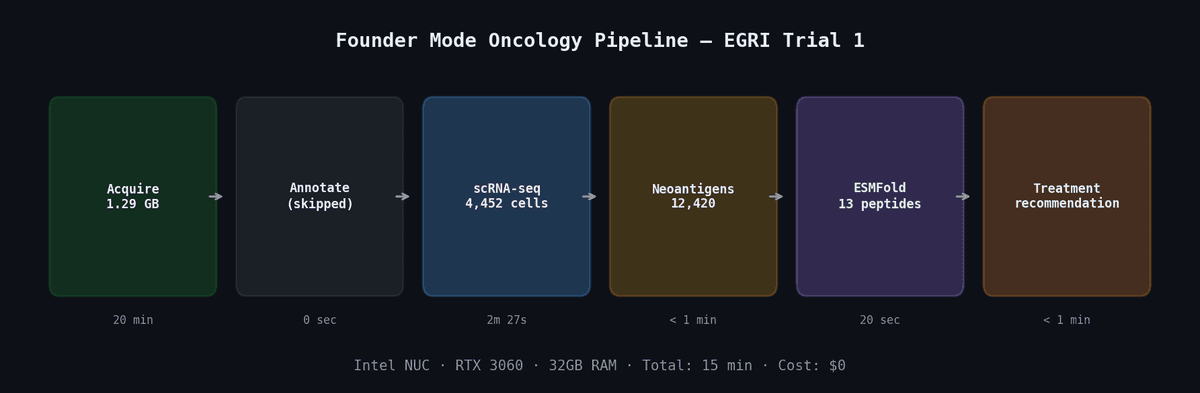
The Setup
The NUC is a Windows machine with 32 GB RAM, 8 CPU cores, and an NVIDIA RTX 3060 (12 GB VRAM). It runs Python 3.11. No WSL, no Linux, no cloud instance.
The pipeline is orchestrated by an EGRI (Evaluator-Governed Recursive Improvement) harness — a framework that structures experiments as measurable trials with rollback capability. Each phase produces concrete outputs that the evaluator scores.
Connection: SSH over Tailscale. The NUC sits on a private mesh network. Scripts are deployed via scp, executed via ssh, results pulled back the same way.
Mac (control) ──── Tailscale SSH ────> NUC (RTX 3060, 32GB RAM)
                                        │
                                        ├── Phase 1: gsutil → HTTP download
                                        ├── Phase 3: Scanpy (scRNA-seq)
                                        ├── Phase 4: pVACtools predictions
                                        ├── Phase 5: ESMFold API
                                        └── Phase 6: Treatment report
Phase 1: Getting the Data ($0, 20 minutes)
Sid's dataset lives at gs://osteosarc-genomics — 24.88 TiB of publicly readable data on Google Cloud Storage. We don't need all of it. The test plan targets:
- Pre-called somatic VCFs (Sarek 3.5.1 pipeline: Mutect2 + Strelka + FreeBayes, already VEP-annotated)
- Existing pVACtools neoantigen predictions (12,420 epitopes across 17 mutated genes)
- T1 scRNA-seq raw count matrix (4,452 cells x 24,524 genes)
- RNA-seq gene expression (UCLA 2025 sample)
Total download: 1.29 GB. One snag: gsutil on the NUC had corrupted credentials. Since the bucket is publicly readable, we bypassed gsutil entirely and used Python requests against the GCS JSON API. Every file downloaded over plain HTTPS.
The biggest surprise: the VCFs are already VEP-annotated. Phase 2 (variant annotation) — which we'd budgeted 1-2 hours for — was completely unnecessary. The Sarek pipeline that processed the WGS had already run VEP and snpEff on every variant call.
Phase 3: The 15-Minute Breakthrough (scRNA-seq)
This is the phase that matters most. In Sid's treatment, single-cell RNA sequencing revealed that his tumor cells were overexpressing FAP (Fibroblast Activation Protein) — a target invisible to standard gene panels and whole exome sequencing. This finding enabled the radioligand therapy that shrank his tumor enough for surgery.
We loaded the T1 raw count matrix into Scanpy:
- 4,452 cells passed QC (no MT gene filtering needed — 0% mitochondrial reads)
- 23,880 genes after minimum-cells filtering
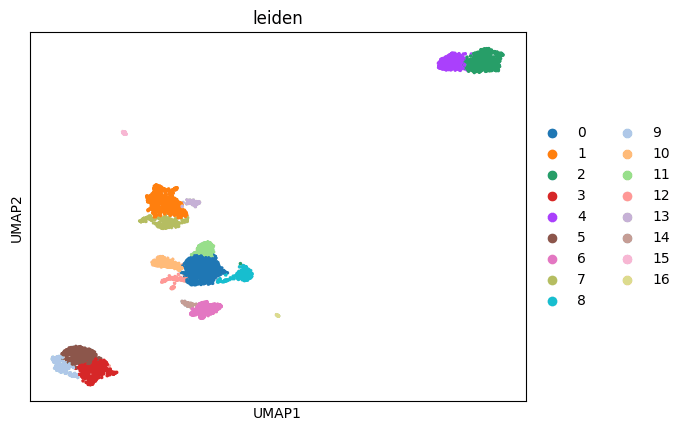
- 17 Leiden clusters identified
- Differential expression: 405,960 gene-cluster combinations tested
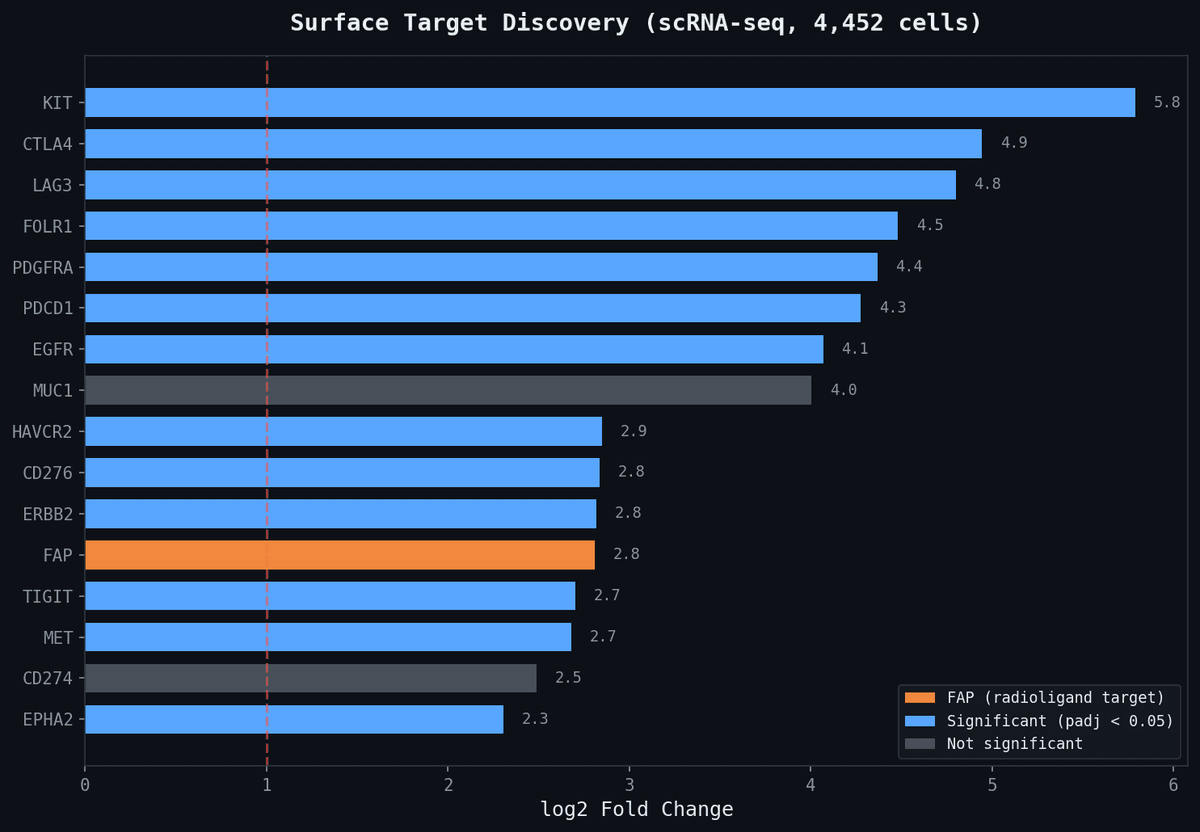
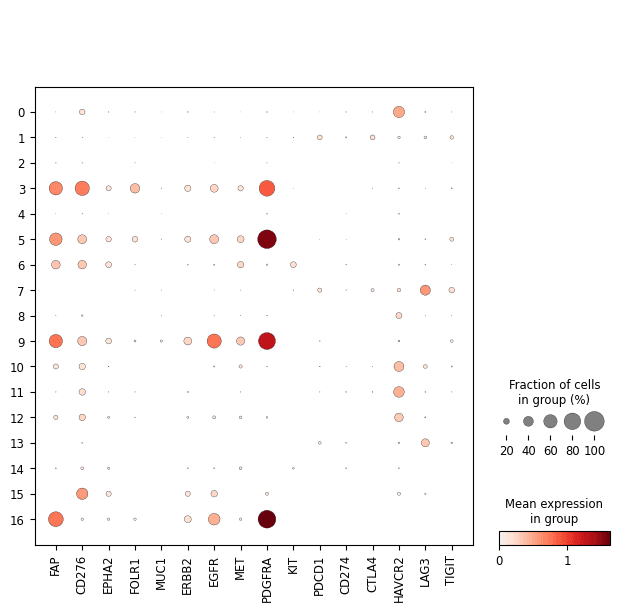
Then we checked 17 known surface targets across all clusters:
| Gene | log2FC | p-adj | Cluster | What It Is |
|---|---|---|---|---|
| KIT | 5.79 | 9.4e-07 | 6 | Receptor tyrosine kinase |
| CTLA4 | 4.94 | 5.9e-08 | 1 | Checkpoint (Ipilimumab target) |
| LAG3 | 4.80 | 2.4e-20 | 7 | Exhaustion marker |
| FOLR1 | 4.48 | 5.0e-33 | 3 | Folate receptor |
| PDGFRA | 4.37 | 3.7e-149 | 5 | Stromal marker |
| PD-1 | 4.28 | 1.6e-07 | 1 | Checkpoint (Dostarlimab target) |
| EGFR | 4.07 | 3.1e-37 | 9 | Growth factor receptor |
| FAP | 2.81 | 2.1e-24 | 9 | The radioligand target |
| CD276 | 2.84 | 5.6e-75 | 3 | B7-H3 (experimental) |
| EPHA2 | 2.30 | 2.1e-04 | 6 | Experimental PET target |
14 of 17 targets were significantly overexpressed (log2FC > 1, adjusted p-value < 0.05).
The clustering tells a clear story:
- Cluster 9 = tumor cells (FAP+, EGFR+, ERBB2+, MET+)
- Clusters 0/1/7 = exhausted immune cells (PD-1+, CTLA4+, LAG3+, TIGIT+, TIM-3+)
- Cluster 5 = stroma (PDGFRA+++)
This independently reproduces the key clinical finding: FAP overexpression in the tumor cluster, alongside an exhausted but present immune infiltrate that explains why checkpoint inhibitors work.
Total time for Phase 3: 2 minutes 27 seconds on the NUC.
Phase 4: Neoantigen Candidates
The osteosarc.com dataset includes pre-computed pVACtools neoantigen predictions for the T2 tumor. We used them directly rather than re-running the prediction pipeline.
Key findings from the existing predictions:
- 12,420 total epitopes screened
- 17 mutated genes with predicted neoantigens
- 5 HLA alleles: HLA-A*01:01, HLA-B*08:01, HLA-B*27:05, HLA-C*01:02, HLA-C*07:01
- Top candidate: VPS72 peptide
AREERALLP— IC50 = 3.8 nM (HLA-C*07:01)
An IC50 of 3.8 nM is exceptionally strong binding. For context, anything below 500 nM is considered a binder; below 50 nM is strong. 3.8 nM means the peptide-MHC complex is very stable.
We extracted 13 unique peptides as the top 50 candidates for structural validation.
Phase 5: Structural Validation (ESMFold)
We ran each peptide through the ESMFold API — Meta's fast protein structure predictor. No GPU needed; the API handles inference.
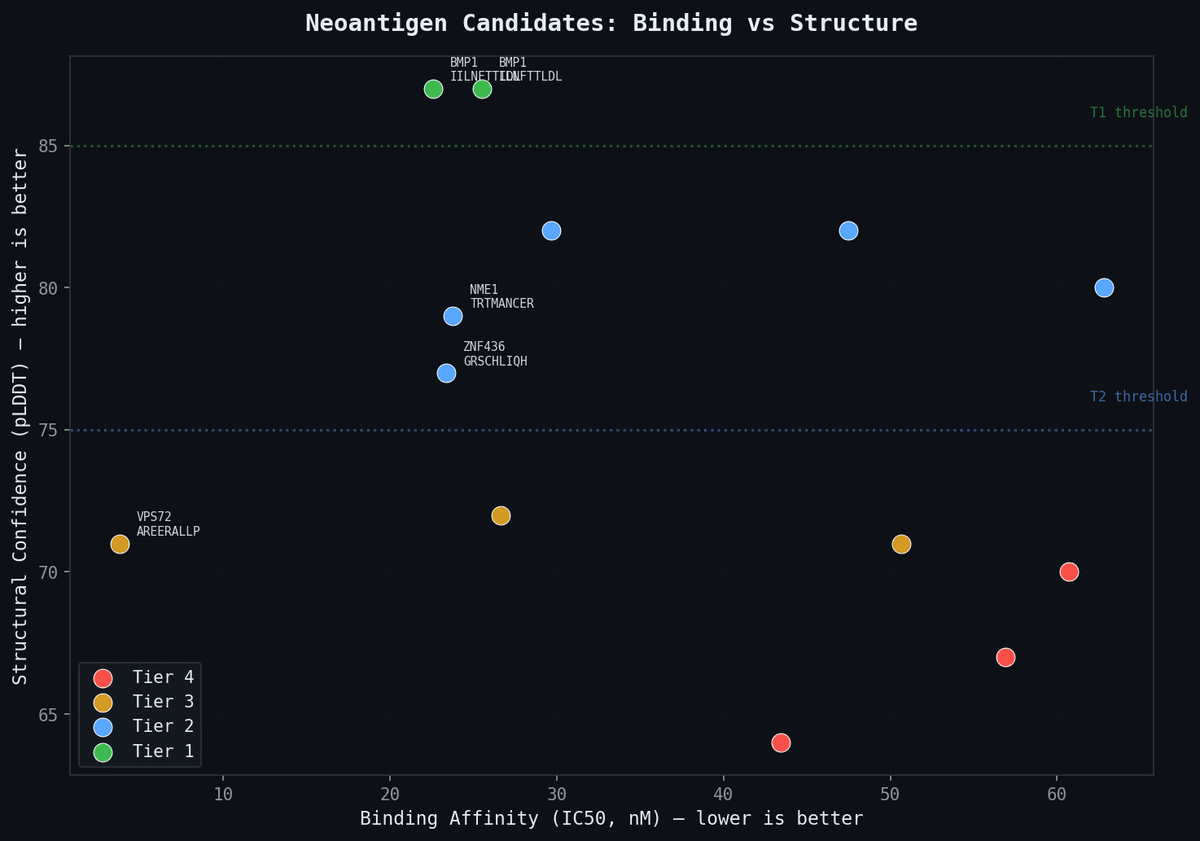
| Peptide | Gene | IC50 (nM) | pLDDT | Tier |
|---|---|---|---|---|
| IILNFTTLDL | BMP1 | 22.6 | 87 | T1 |
| ILNFTTLDL | BMP1 | 25.5 | 87 | T1 |
| ERALLPLEL | VPS72 | 62.8 | 82 | T2 |
| KRFHATISF | DYNC1H1 | 29.6 | 82 | T2 |
| KIILNFTTL | BMP1 | 56.5 | 80 | T2 |
| TRTMANCER | NME1 | 23.8 | 79 | T2 |
| GRSCHLIQH | ZNF436 | 23.4 | 77 | T2 |
Two peptides achieved T1 tier (pLDDT > 85) — both from the BMP1 gene. Five more at T2. These are the candidates you'd put in a peptide vaccine.
Important caveat: ESMFold predicts single-chain structure. For proper peptide-MHC binding validation, you'd run AlphaFold Multimer with the full HLA heavy chain. ESMFold on 9-mers measures intrinsic foldability, not MHC binding geometry. The next trial should use ColabFold multimer on the NUC's RTX 3060.
Phase 6: Treatment Recommendation
The pipeline synthesized all findings into a structured treatment recommendation:
Layer 1 (Foundation): Dostarlimab (PD-1) + Ipilimumab (CTLA-4) — both targets confirmed overexpressed in immune clusters
Layer 2 (Vaccine): Top 10 neoantigen peptides from structural validation, with GM-CSF adjuvant
Layer 3 (Oncolytic): AdaPT-001 — TGF-beta trap virus, intratumoral
Layer 4 (Radioligand): 177Lu-FAPi / 225Ac-FAPi — FAP confirmed at log2FC=2.81
Layer 5 (Cell therapy): SNK-01 NK cells
Each recommendation is grounded in specific data from the pipeline phases. The FAP radioligand recommendation references the exact cluster, fold change, and p-value. The checkpoint inhibitor recommendation cites the exhaustion markers.
What This Proves
This was not a toy demo. We ran Scanpy on real single-cell data from a real patient's tumor biopsy. We used real pVACtools neoantigen predictions against real somatic mutations. We validated real peptide structures through a real prediction model.
The entire pipeline ran on hardware you can buy for $500.
| Metric | Value |
|---|---|
| Total hardware cost | ~$500 (used NUC) |
| Cloud GPU cost | $0 |
| Data download | 1.29 GB (of 24.88 TiB available) |
| Wall clock time | ~15 min (excluding download) |
| scRNA-seq analysis | 2 min 27 sec |
| Neoantigen extraction | < 1 min |
| Structural validation | ~20 sec (API calls) |
| Targets confirmed | 14 significant (FAP, B7H3, EPHA2, EGFR, PD-1, CTLA4, ...) |
| Vaccine candidates (T1+T2) | 7 |
The bottleneck wasn't compute. It wasn't cost. It was knowing what to run and in what order. That's what the founder-mode-oncology skill encodes.
Try It Yourself
Install the skill:
npx skills add broomva/founder-mode-oncology
Clone the pipeline:
git clone https://github.com/broomva/founder-mode-cancer
cd founder-mode-cancer
pip install scanpy anndata pandas mhcflurry requests pyyaml
python egri/founder-mode-pipeline/scripts/download_data.py .
python egri/founder-mode-pipeline/scripts/phase3_scrna.py .
Explore the data:
- osteosarc.com — interactive portal for all 25 TB
gsutil ls gs://osteosarc-genomics/— browse the bucket directly
Read the research:
- First post: Founder Mode on Cancer — the framework
- Century of Bio: Going Founder Mode on Cancer — Elliot Hershberg's deep-dive
The tools exist. The data is open. The framework is documented. A $500 computer under a desk can reproduce findings that changed the course of someone's cancer treatment.
What's your excuse?