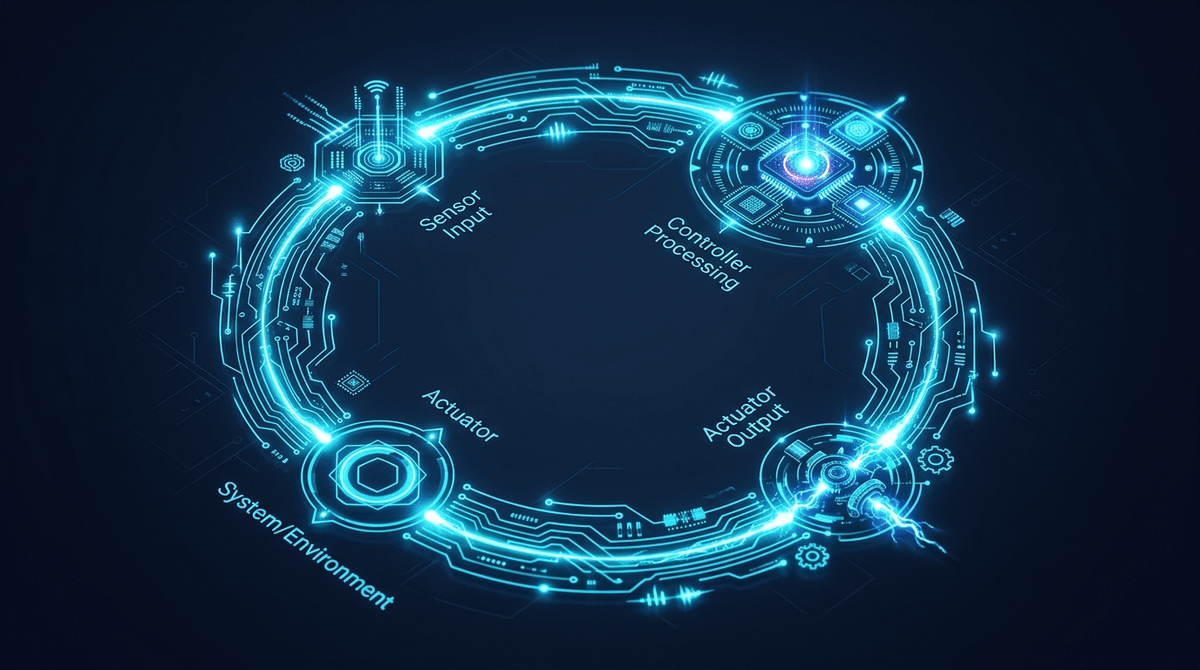
The framework for which all this is envisioned and processed with ever growing engineering rigor — the purpose behind it — is an ever-searched strive for balance. To somehow use the intellect to describe a process of mental analysis regarding any subject, while sorting out the biasing over unknown dynamics described in temporal data collected from sensors.
This could be understood as a machinery to stay tuned to one, or infinite, inputs.
The Prime Definition
We look forward to create a system that can transform input information — encoded in bits — into helpful insights regarding the dynamics of any system. The output of such function over time is used to alter the dynamics of the system it is analyzing, via some actuator of appropriate field.
Important information can be obtained both in open and closed loop, structured in arrays of temporal and process features: a map of the spatial state of relationships between nodes. Using the approach of telecommunication experiences, analysis within the frequency domain can be carried out. Dynamic programming. State space LMI. Different mathematical approaches with a concentric point that defines the overall dynamical description of the whole.
The core purpose of this enterprise is to find this prime definition — the place where all practical and theoretical definitions of dynamics converge. Where a mathematical concept can be structured to define multiple, highly intertwined levels of processing nodes, as well as simple SISO systems.
Any level. Cosmos. Universal approximation and the determinism of Laplace.
For Stability, Control
There is a precise language for how much a system can tolerate before it breaks:
Phase margin > 0. Good value: 45 to 60 degrees. Measured as the difference between the phase angle and -180 degrees when the magnitude of the open loop system crosses 0 dB. This is the buffer between responsive and reckless — how close the system runs to the edge of oscillation without tipping over.
Gain margin > 0. Good value: 5 to 10 dB. How much the gain at the phase crossover frequency can be increased before the system is driven to instability. The tolerance for amplification before breakdown.
These are not just numbers on a Bode plot. They describe a universal condition: every system that persists has positive margins. Every system that collapses has let them erode to zero.
Ver Lo Bueno en Lo Malo
Cambiar la descripcion de un sistema basado en los fallos deterministicos estimados de sus funcionalidades. How would you define the way to compare? By defining, through other control systems, variables that alter the dynamics — based on algorithms of vanguard — and develop improvement for desirable control parameters toward a predetermined final value of n variables.
In natural descriptions, when it is life being analyzed — and in general, time — of things that move or not, but that equally generate a dynamic: forces between electrons, the energetic nature of time and its determined initial configuration. Deterministic definitions of temporal states and dynamics, of any interaction between parameters that interact energetically in a defined system.
To see the good in the bad is to read the error signal not as failure, but as information. The deviation from setpoint is the most valuable measurement in any control loop. Without it, there is no correction. Without correction, there is no stability.
A Way of Self Enhancement
Generate series of self-directed activity in a background process. Passive workers that deliver products useful for self-development — a way of self-optimization in time.
This is the return of various parallel controls: modern approaches such as disturbance rejection for a determined wanted output, or intelligent approaches given by inferential statistics, data science, machine learning, deep learning, reinforcement learning — AI, per se.
In a direct human sense, this shall be intrinsic self-developed paths to control ourselves. An evolutionary effect. The control of the body, needed to acquire the enhancement of the mind.
The self-conscious — for a natural approach — or the metrics of a digital system, directing sustained development in time: this is the challenge for the design. The key for the perfect design.
Now, in a macro scale — contemplating ever-increasing parallel and series computation, of which the control run is obtained — an optimized natural selection emerges. For the human, naturally. For the digital human, artificially.
The perfect design is not a destination. It is a sustained development in time. A life — natural or artificial — that keeps its margins positive, its feedback loops honest, and its error signals legible.
For stability, control. For enhancement, persistence. For balance, the strive itself.